Monthly Archives: January 2015

loading..

Dissecting the Deep Passing from the 2012 Patriots-Seahawks Game

With the Seahawks and Patriots playing in the Super Bowl, I thought it would be pertinent to take a look back at the last time the two teams met, in the 2012 season. You can bet that both the Seahawks and the Patriots have been taking a look at this film to see what happened, so I took a look at it as well. What I found was a resilient Seahawks team that despite being down 23-10 in the fourth quarter, came back to win. Specifically, the Seahawks were able to come back because of the deep pass, which I will be exploring in this column.

A lot has changed since 2012 for both teams, the Patriots in particular. In 2012, Devin McCourty was still a CB, Darrelle Revis was still a Jet, and Aaron Hernandez was still a NFL player. As such, the starting back four for the Patriots on defense consisted of McCourty, Kyle Arrington, Tavon Wilson, and Patrick Chung. Alfonzo Dennard came in during nickel situations. Up front they still had Vince Wilfork and Chandler Jones. Rob Ninkovich, while still on the roster, was designated as a starting LB rather than a DE. The other two LBs at the time were Jerod Mayo (who is injured) and Brandon Spikes (who is a Bill). Dont’a Hightower was on the team, but was inactive for this game.

On offense, the Seahawks actually look somewhat similar to how they do today. The offensive line still features Russell Okung, Matt Unger, and James Carpenter, Wilson is still the QB, and Lynch is still the RB. However, they no longer have Sydney Rice or Golden Tate as WRs. Doug Baldwin, however, is still on the team and is probably their most prominent receiver.

Schematically, however, the teams appear very similar to what I expect to see tomorrow (when the Seahawks’ offense is on the field, at least). On offense, the Seahawks ran early and often, and used play action constantly. They did not use the pistol formation or a shotgun formation quite as much as I would have expected, but ran the vast majority of their plays from under center. Still, they will put a very similar offense out there in Arizona, prefering to run the ball and attack deep off of play action. On defense, the Patriots are also very similar to what I expect to see in Super Bowl XLIX. They ran single high coverage a lot (although McCourty will be the one deep now instead of Wilson) with man coverage on the outside (Browner and Revis instead of McCourty and Arrington).

With the differences and similarities between the 2014 and 2012 squads discussed, let’s take a look at the game from 2012 and see what we can learn about the Seahawks’ deep passing game:

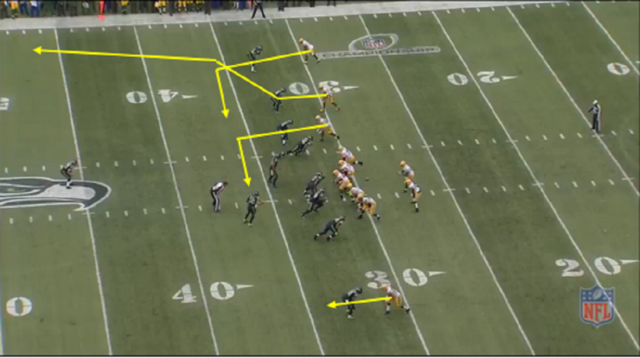
3-9-SEA 16 (Q1, 4:25) (Shotgun) R.Wilson pass deep middle to D.Baldwin to NE 34 for 50 yards (K.Arrington).

Something that the Seahawks like to do when they take deep shots against a single high safety is run a deep crossing route underneath the deep safety hoping to draw him up, and allow a one-on-one shot deep. The Patriots have man coverage on the outside and only one safety deep on this play.

On this play, that strategy works to perfection. The crossing TE draws the safety up, Wilson takes the deep shot, and Doug Baldwin makes a good catch over Kyle Arrington. Wilson also did a good job moving out of the pocket to find an open space to throw the football deep.

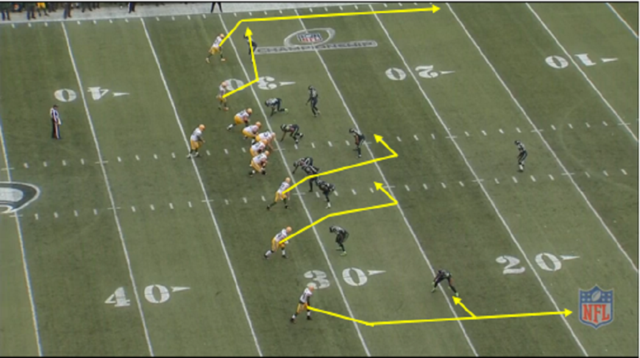
2-4-NE 28 (Q1, 3:13) R.Wilson pass incomplete deep left to G.Tate.

The Patriots once again use a single high safety, and Seattle looks for a deep shot off of play action again. There’s man coverage on the outside, and Wilson looks to target Golden Tate at the bottom of the screen.

While there is some contact at the top of the route, Wilson just overthrows this ball.

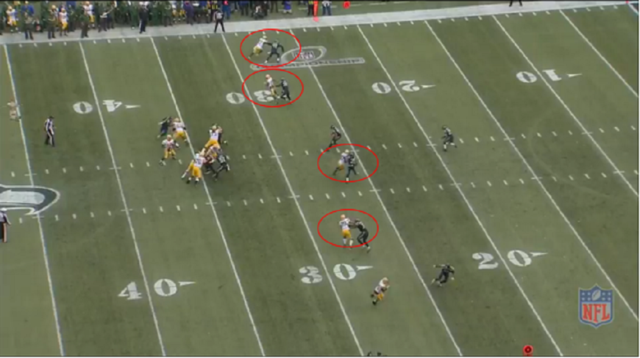
1-15-NE 24 (Q1, 1:59) R.Wilson pass deep middle to D.Baldwin for 24 yards, TOUCHDOWN.

Once again, the Patriots have man coverage underneath and a single high safety. This is something there was a lot of in this game and is something we’ll see in the Super Bowl, as well, so you can expect the Seahawks to try to attack the Patriots in a similar manner. The TE runs a dig route, and that draws the safety up.

Because the TE drew the safety up, Baldwin has a one-on-one in the slot. He actually slips coming off of the line. Wilson faces pressure up the middle, and does a great job of scrambling to get away from it. As Wilson is scrambling, Baldwin gets a step on his man. Wilson recognizes this, and makes a nice throw, which is turned into a TD by a very good catch by Baldwin.

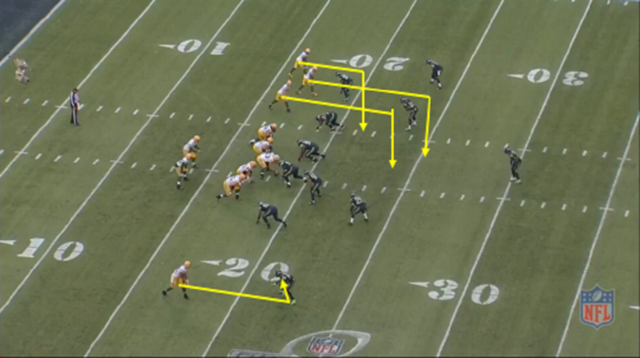
1-10-SEA 42 (Q3, 8:18) R.Wilson pass incomplete deep left to G.Tate.

On this play, the Patriots defense is “2 Man Under” which means that they have two safeties in deep zones and man coverage underneath. Wilson will target Golden Tate at the bottom of the screen.

The CB on Tate makes a mistake by trying to jam him, and Tate blows by him. With a step on the DB, Wilson has an easy decision to throw it to him. The throw is just a bit off, it’s a step too long and a step too far towards the sideline, and Tate can’t reel it in.

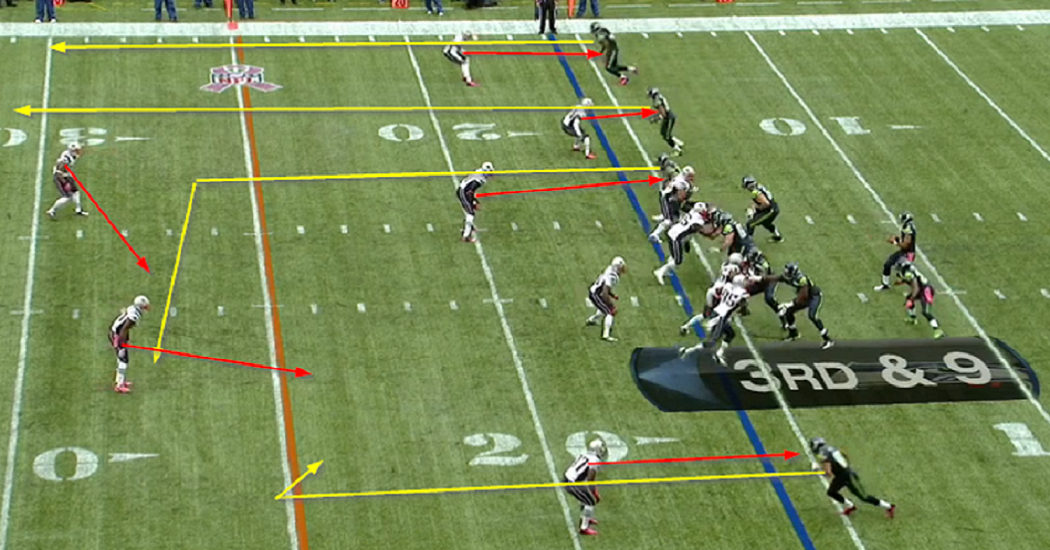
3-20-SEA 32 (Q3, 7:32) (Shotgun) R.Wilson pass incomplete deep middle to B.Obomanu (T.Wilson).

The Patriots are running 2 Man again on a 3rd and 20. Because of the distance, all four Seahawks WRs run routes at least 20 yards downfield, and three of those are go routes. Wilson will target Ben Obomanu, who is the receiver closest to the offensive line at the top of the screen.

The decision Wilson makes is in my opinion an ill-advised one. Obamanu is double covered. Then again, I’m not sure Wilson really has any option downfield. While this is easily defended by Tavon Wilson, even if it’s intercepted it’s basically a punt. Not a terrible choice, if only because of the down and distance.

1-10-SEA 20 (Q4, 13:29) S.Rice pass incomplete deep right to G.Tate.

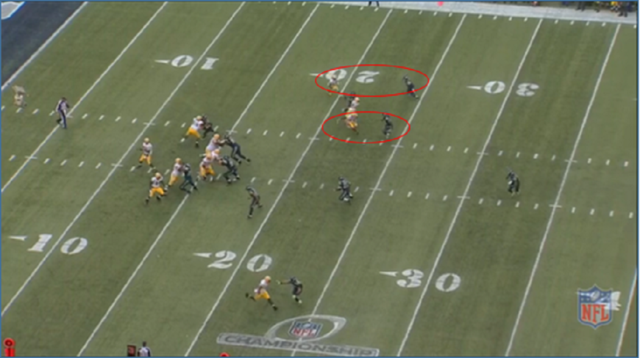
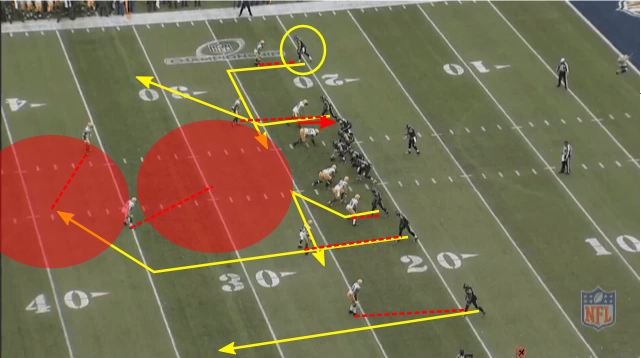
While the Seahawks no longer have Sydney Rice to throw this ball, if you’re looking for a trick play from the Seahawks this might be the one. One of the concepts the Seahawks use on this play is the Jet Sweep, which they have a history of using. The trick draws both the safety (Chung) and the CB covering Baldwin up towards the LoS. This leaves Baldwin open for the throw from Rice. It’s almost caught, too, but Chung also interfered on the play so the Seahawks got the yardage anyway.

1-10-SEA 17 (Q4, 9:17) R.Wilson pass deep middle to G.Tate to NE 32 for 51 yards (D.McCourty) [B.Spikes].

The setup to this play is very similar to what we’ve seen before from the Patriots (and the Seahawks). A route combination with one receiver crossing deep and the other running a go route against man coverage with a single high safety for the Patriots.

And, once again, the underneath route draws the single high safety giving the Seahawks a shot at single coverage on the outside. Wilson once again makes a great throw, and Tate makes a great catch over Devin McCourty.

1-10-NE 46 (Q4, 1:27) R.Wilson pass deep middle to S.Rice for 46 yards, TOUCHDOWN.

This is the final play of the game, a deep bomb for a TD to complete the comeback for the Seahawks (sound familiar?). On the play the Pats are running a cover 2 and the deep safety is responsible for the go route that Rice runs.

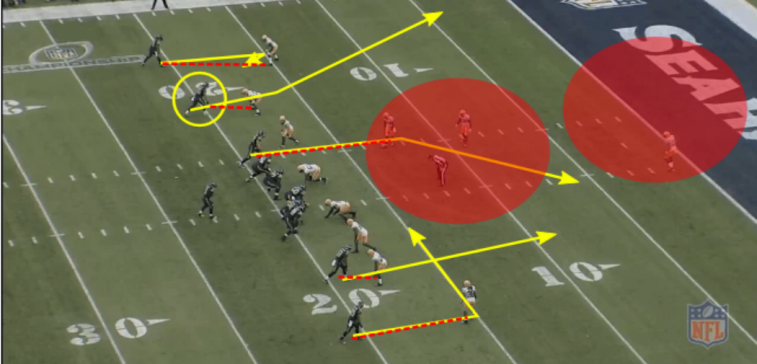
The reason this play is successful is because of the route Rice runs and poor discipline from the safety. As you can see, the deep safety, Tavon Wilson, gets his hips turned to the outside. Once Rice sees that, he cuts back toward the middle and runs right by him. Wilson makes the throw and Rice makes the catch for what would be the winning TD.

On the game, Wilson only actually completed 16 passes. Those completions went for nearly 300 yards. Deep passing is really what allowed the Seahawks to come back in the game, as Wilson’s four completed deep passes went for an astonishing 171 yards and 2 TDs.

Even in just his 6th career game, you can see what makes Wilson such a good QB. He is great at avoiding sacks, and he is accurate on deep passes, often making intelligent decisions. You also see the basis for the Seahawks offense, which is establishing the run and then attacking a single high safety deep off of play action. While Seattle did a poor job of establishing the run in this game (only 85 yards on the ground) they still faced a single high safety a lot and exploited that.

Things have changed a lot for the Patriots defense since 2012. They’ve become one of the best secondaries in the league. The Seahawks’ receiving corps appears to have worsened. How the Seahawks use the deep ball in the Super Bowl could determine the matchup. Wilson threw four interceptions in the NFC Championship Game, but was undeterred, and eventually a deep pass became the winning TD. Similarly, I think the Seahawks will attack the Patriots deep early and often in this game. If they connect on a couple of those passes, it could swing the tide of the game drastically.
Patriots Pass Defense vs Andrew Luck (34 YDs, 0 TDs, 2 INTs) Second Half

The score is 7 to 21, the Patriots are coming out with the ball in their home stadium and the Colts need to make plays on offense quickly if they want to stay in the game. Well, that doesn’t end up happening.


Operation: Doomsday

This isn’t where the Colts envisioned the game would be at when they were preparing for the AFC Championship game. They thought they could find some space for their deep passing game and when they didn’t, that Luck could have enough time to get to his underneath routes. Nope.

When they came back on offense, the Colts first play was an attempt to follow the openings they found in the Patriots man defense.

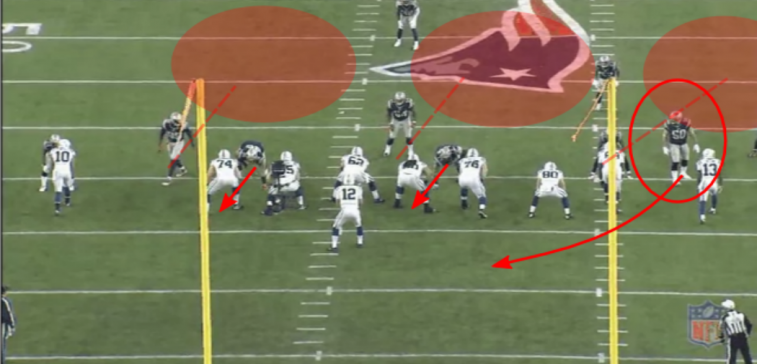
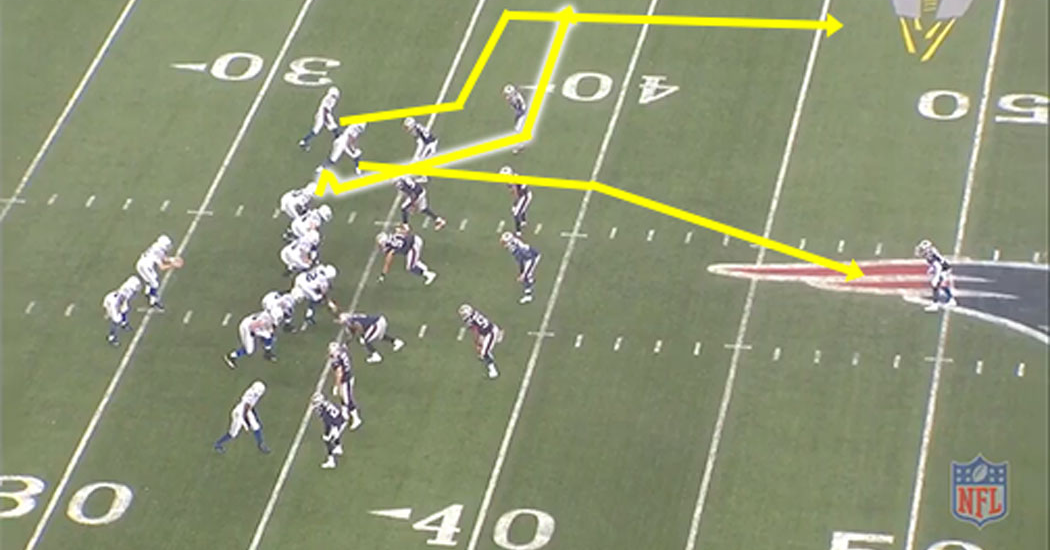
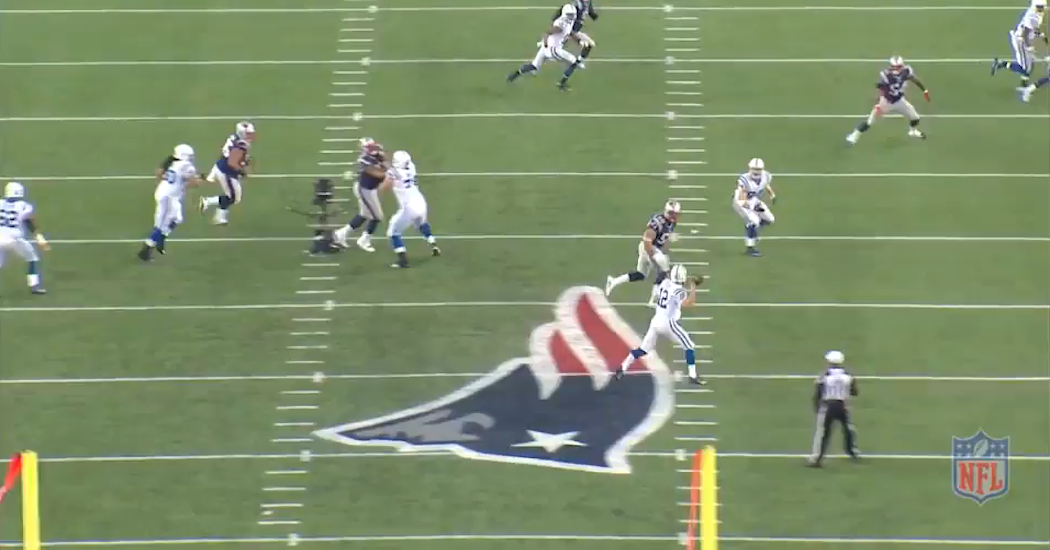
On this play, WR #13 Hilton, TE #80 Fleener and TE #83 Allen clear out all the space behind them for WR #87 Reggie Wayne to come through and be wide open for an easy catch. However, the Colts shifted their line to the left and as a result LDE #50 Ninkovich has a free unblocked rush on Andrew Luck. I guess that solves the problem of RT #76 Reitz getting beat over and over again but it doesn’t stop Ninkovich.

Here, it’s Moncrief’s Skinny Post blocking Dwayne Allen’s man, leaving Allen open for an easy throw to the outside. These plays worked for the underneath and the Colts kept using them throughout the second half but they’re also only short yardage gains and eating up time.

They continue using these Underneath picks but they still mix in their deep routes in-between each play. It’s necessary in order to keep the Patriots from coming up and because they need to try and hit a big play to get the game back under control but it’s a bit of a doomsday strategy, since they know they likely aren’t stopping the Patriots drives on offense and they’re just trying to keep the drives alive for long enough to hit one big play.

However, they did discover one play where they got exactly what they wanted, a wide open deep receiver against Cover-1 Man.

The Combination of two In Routes from the right side and Hilton’s Slant release turning into a Post completely breaks down the Patriots Cover-1 man. As already explained, the Patriots Cover-1 uses a lot of passing off when the player being covered breaks inside, leaving that player to take man on another player that crosses to the opposite direction or just sit in zone.

Here, Hilton does a release into the middle of the field and then starts up vertically- Arrington sees him breaking inside and bumps him. Once he sees Allen coming down, he takes on Allen along with Hightower. Then the delayed In route from Herron at the top of the screen pulls Ninkovich down from his zone. So who’s on Hilton? No one. Luck doesn’t see it and chooses to scramble instead.


Even If It Worked Out

As chronicled in Part 1, Luck and Hilton couldn’t connect no matter what the situation. On the last play, Hilton’s wide open and Luck doesn’t see it. On this play, the underneath pick works exactly as drawn up but Revis doesn’t care.

Moncrief slants inside before taking a vertical, plowing into Revis and Arrington and making Hilton wide open. Revis reads this play perfectly, peels off of Moncrief and cuts the throwing lane. This isn’t Revis’ duty on this play, he just makes a quick decision and cuts it off.


They Might Be Rushing

Even when the Patriots are ahead they always make some kind of adjustments in order to stay ahead. In the second half, they began bringing up their Linebackers to the line and hiding their rushers. Now, instead of dealing with just the 4 linemen on every play the Colts offensive line had to figure out which of the LBs might be replacing a rusher.

#54 Hightower comes up in the B gap on the left side of the line (QB perspective) and at the snap manages to draw attention from both of the LT and LG despite not rushing, leaving Coby Fleener on a 1v1 with Chandler Jones. They do this on nearly every passing play in the 3rd quarter.

Both #91 Collins and #54 Hightower are up at the line this time, drawing three blockers to them (Center, Right Guard, and RB). Ninkovich gets a 1v1 with Reitz despite the Colts having 6 blockers against 3 rushers.

It’s more than just faking the LBs, when they do bring it, the Colts can’t handle it. In the play below, the Colts have 7 blockers against 4 rushers and they still allow someone into Lucks face.

The Patriots crash the RDT #96 Alan Branch towards the LG while RDE #95 Chandler Jones bends to the right, leaving a huge gap for Collins to rush through where Dwayne Allen and Zurlon Tipton are left to pick him up. But when the snap goes off, Collins bends a little to his left at the rush, pressing the hole he’s trying to rush through just like a Running Back before cutting all the way to the outside of the B gap, lowering his shoulders and giving Allen and Tipton very poor angles to block him from. This whole play just makes you think Collins played Running Back at some point in his life.


Was There Ever A Doubt?

The Colts under Luck/Pagano have now played the Patriots 4 times. They’ve lost by an average of 29 points in each game while only managing to score an average of 18. The average score they’ve lost by is more points than this duo has ever managed to score against the Patriots (high of 24 in Luck’s rookie year). The Colts deep passing attack had almost no chance in this game and they abandoned the run immediately after their first possession. The difference in these two rosters is vast but so was the coaching.

The Colts did manage to find some holes in the Patriots passing defense through the pick plays and in/under routes that might give Seattle some ideas for the Superbowl but it wasn’t enough to give the Colts a chance to win.

Click Here For The First Half

See Every Passing Play In The Half On The Next Pages

How the Packers Offense Attacked Seattle

As I dissected the game film from the NFC Championship game two Sundays ago my lasting observation was how weird of a game it really was, particularly in the first half. Fueled by a string of Seahawk turnovers, the Packers regularly began their drives in outstanding field position. But while the Packers’ offense seemed ubiquitous in the first half, at halftime they had come away with only 16 points. Even from play-to-play the offense surged forward and backward. Eddie Lacy would pop off a run for 6 yards only to be swarmed and driven back on the next. The entire flow of the game was bizarre. As we dive in to what the film has to show us with an eye towards the Super Bowl, what we’ll find is that schematically it seems the Packers were able to find weaknesses in the Seahawks defense but was unable to win the one-on-one match-ups necessary to convert strategy into victory.


Chasing Bubbles

We’ll begin with the running game. While the Seahawks remain one of the best run defenses in the league, injuries up front have left the interior of the defense a little bit softer than usual. Green Bay, with a hobbled Aaron Rodgers, clearly wanted to establish the inside run game to open things up for and take pressure off of their quarterback. They attempted to accomplish this by aiming their inside run game at an area of a defense known as the “bubble.”


A bubble is an area of the defensive front where an offensive lineman is left uncovered by a defensive lineman. These are often vulnerable spots to attack with the running game because the uncovered offensive lineman can be used to double-team at the point of attack or release into the second level of the defense. The Packers are going to use the inside zone to do both.


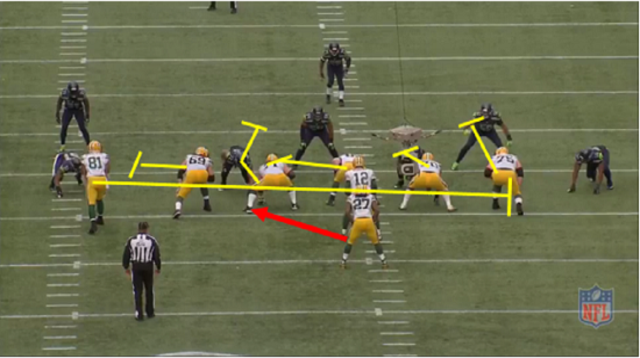
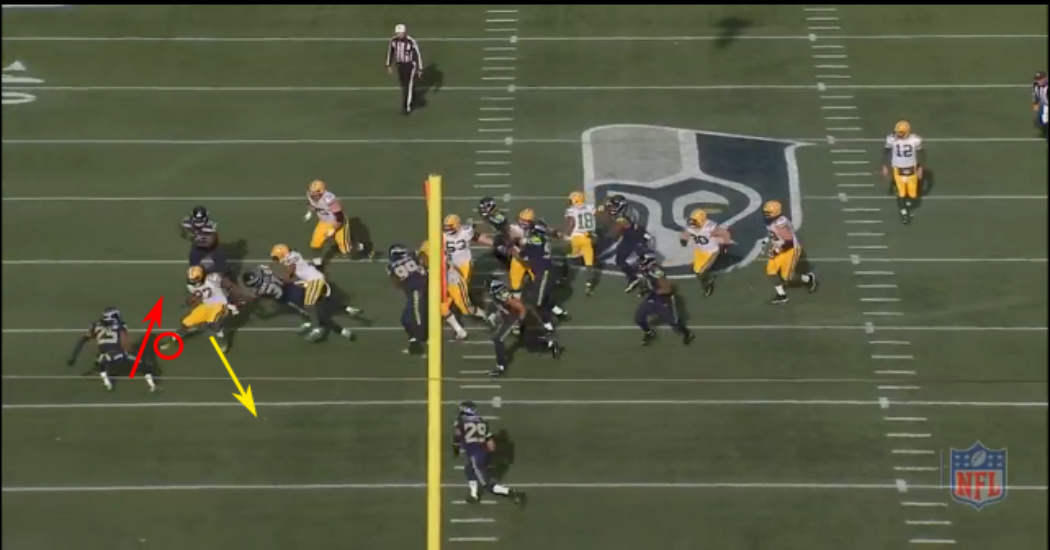
Towards the end of the first quarter on first and ten Green Bay is in 11 personnel with the tight end Quarless aligned in the backfield as a fullback. Seattle uses their nickel package with a 4-3 over defensive alignment. Although #94 of Seattle is shaded towards Green Bay’s right guard he is responsible for the “A” gaps on either side of the center, effectively leaving #70 of Green Bay as an uncovered lineman. This right guard will help the center establish his block on #94 before releasing to the linebacker. The tight end Quarless aids the left guard in his block on #99, but the guard is unable to release onto the linebacker. Luckily for them Eddie Lacy uses his vision to bail them out. We’ll circle back to Andrew Quarless later.


Notice how Lacy knows he has two lanes to work with, the beauty of the zone run. He sucks the linebacker and nose into the cutback lane before firing out to open grass. By and large the Packers win the one-on-one battles and the result is a seven yard run on first down, opening up an array of options for the offense. Green Bay ran this play repeatedly throughout the day, nearly always targeting the defensive “bubble.” Unfortunately for them, it wasn’t all good.


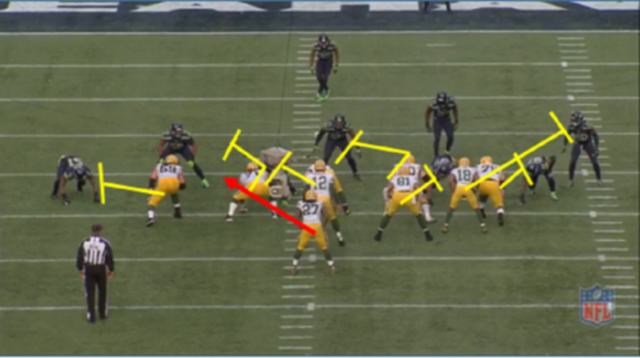
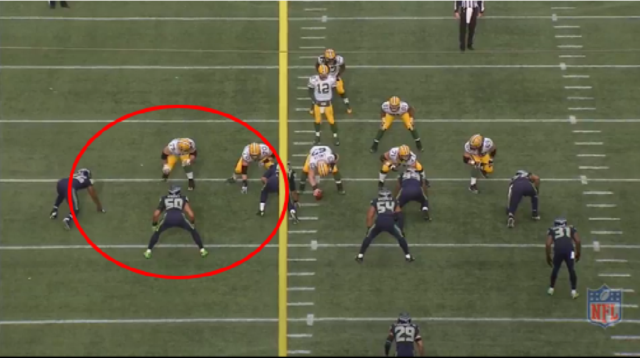
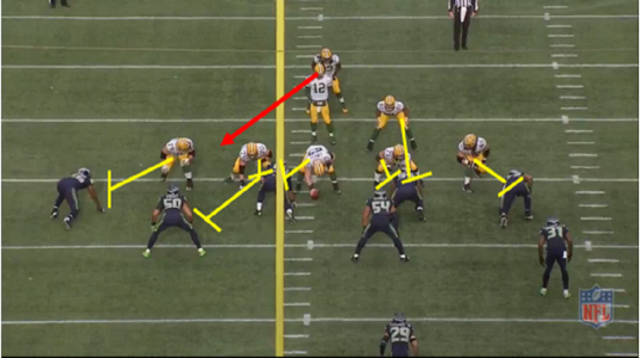
Early in the second quarter on second and five Green Bay aligns in the Pistol with 11 personnel. Seattle counters with their nickel package, splits both defensive ends out in a wide alignment and shades the nose tackle in a 2 alignment directly over the right guard. This forces the center to slide all the way over and double team Michael Bennett before the left guard releases onto the middle linebacker. Quarless slides all the way across the formation to seal off Cliff Avril on the backside of the play. Although Randall Cobb is not shown in this shot he is aligned in the slot and is responsible for blocking down on Kam Chancellor.


Michael Bennett sniffs out the double-team, splits it and just manhandles the center on his way to Lacy. Asking the center to slide all the way over to block Bennett is a tall task, however he does have a double-team with the guard that is designed for him to be able to establish leverage so that the guard can release to the linebacker. Most of the other blocks are solid but the Packers are unable to win a crucial one-on-one and it costs them. Lacy can’t bounce outside because Irvin has good contain and he can’t cutback because Cliff Avril is waiting. That’s right, the Cliff Avril who was on the back end of the play. The Cliff Avril whom Andrew Quarless was supposed to take care of. Quarless totally whiffs on his block; not committing fully to cutting Avril but instead sheepishly kneeling as if discovering a rogue quarter on the turf. This allows Avril to block the cutback lane and leads us into our next section of study.


“Lo, I am become Gronk: The Destroyer of Worlds”

In today’s NFL teams are now, more than ever, looking for tight ends who both are strong blockers in the run game and have the physical prowess to win match-ups in the secondary. The usage of the tight ends in Green Bay’s offense against the Seahawks showed some interesting trends that can give us more insight as to why the Packer’s offense sputtered at times and exactly how important Rob Gronkowski will be to the Patriots in the Super Bowl. We’ll start by looking further at the run-blocking by Green Bay.


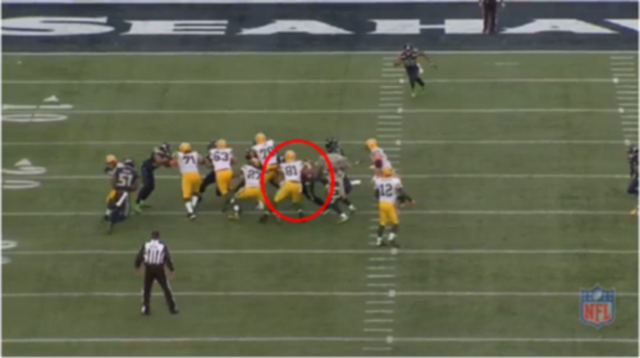
With 10:49 to go in the second quarter with the ball on their own forty-four yard line, the Packers use 11 personnel on third and two with the tight end Quarless once again aligned in the backfield. Seattle continues to counter Green Bay’s 3-wide, 1-tight end sets with their nickel package, aligning in an over front. Pre-snap motion by Cobb leaves him in the backfield just off the hip of the right tackle and draws the attention of Kam Chancellor who steps down into the box. Once again Green Bay sees the bubble in the defense on the weak side of the formation and dials up the inside zone with a small wrinkle: Quarless and the right guard will double-team Bennett initially before the guard releases onto the middle linebacker.


This shot says it all. Quarless is standing straight up and has no leverage while Bennett puts his shoulder into Quarless’ numbers and drives through his gap. Lacy stutter-steps as if he wants to cut back but plows ahead knowing he needs two yards and Bennett is going to be diving at his heels. After this point in the game Richard Rodgers got the majority of snaps at tight end. He fared better than Andrew Quarless but overall the run-blocking by the tight ends of the Packers was less than stellar in this game. The Seahawks will now face probably the best run-blocking tight end in the game right now in Rob Gronkowski. In the days leading up to the game I’m sure we’ll hear all kinds of conjecture about how the Seahawks will defend Gronk in the passing game but his run blocking might be one of the most important advantages the Patriots have over other teams who have fallen to the Seahawks. While we’re on the subject though, let’s look at how the Packers tried to create mismatches for Richard Rodgers.


In the second quarter on second and fifteen with 1:14 on the clock the Packers have trips to the right and split Richard Rodgers out wide to the left. Seattle once again sees Green Bay in 11 personnel and goes to the nickel. They align with two deep safeties, showing man coverage across the board. Instead of keeping cornerback Byron Maxwell on the outside and allowing KJ Wright to be matched up against Jordy Nelson, Wright follows Rodgers and gives him a five yard cushion.


KJ Wright is one of the best cover linebackers in the league right now and by and large played really well in this game, particularly in the middle of field. We can see Seattle’s confidence in him once the ball is snapped as both safeties shade towards the strong side of the formation, with Earl Thomas splitting the trips and Chancellor guarding the middle of the field. This leaves Wright with very little help over the top and is probably his reason for giving Rodgers a generous cushion. Aaron Rodgers sees the man coverage and hits the tight end on a quick hitch. The Packers go back to the cookie jar on the next play, with very different results.


On third and ten the Packers align in the same formation but the Seahawks respond by putting Kam Chancellor out wide on the tight end and playing press-man across the board. The Seahawks bring the blitz, leaving a deep safety in the middle of the field for help over the top shaded towards the strong side. Let’s see how Chancellor fares split out wide in this one-on-one.


Chancellor manhandles Rodgers, getting a jam immediately and disrupting the route so effectively that we can only make an educated guess as to what it was supposed to be. The Seahawks’ man coverage holds up, even with a rub on the outside, and it results in an incompletion. This sequence of plays gives us some small insight into how the Seahawks are willing to match up with tight ends aligned to the outside of the formation. Although I doubt the Seahawks would leave Gronk in single coverage with no help over the top, expect the Patriots to use Gronkowski’s alignment to create favorable match-ups for not only him but for the other receivers. For instance, if New England was to use the same formation as the Packers used it would be much more risky for the Seahawks to shade their safeties so far to the strong side. This could potentially create openings for the receivers on the other side of the formation. The Packers used these spread out trips formations a lot in this game. There is, however, a problem with spreading the receivers out like this.


This is My Jam

One of the things that makes the Seahawks so effective defensively is their ability to play relatively conservative coverages in an aggressive style. Seattle will regularly play simple zone coverage but instead of aligning the corners deep, closer to where they will drop, they will walk them in press coverage and attempt to disrupt the receiver’s timing. This also allows the cornerbacks to carry the receiver up the field, making short routes like curls and quick hitches more difficult. When Green Bay aligns in their spread looks it leaves their receivers vulnerable to the rather handsy Seattle defensive backs who can line up directly across from them.


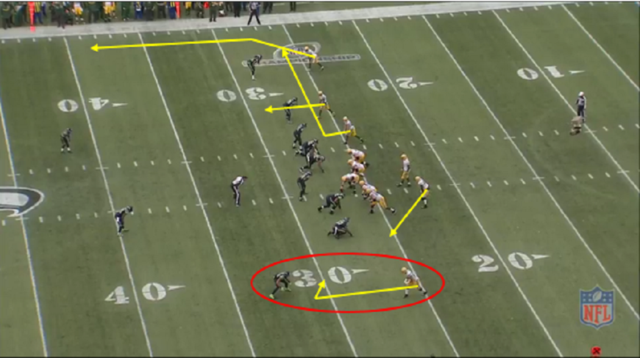
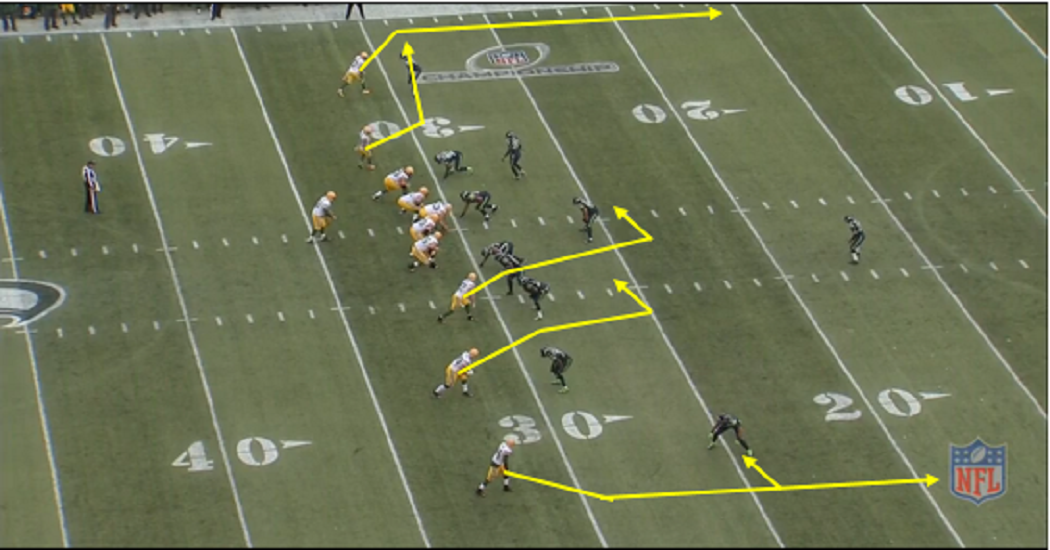
It’s the fourth quarter, second and 7, with 11:45 left to go in the game. Green Bay splits James Starks out wide to the right and begins with Randall Cobb aligned in the backfield. Cobb motions into the left slot and the Packers end up in a spread five-wide formation. Seattle brings in their nickel package and aligns their defensive backs in press coverage. KJ Wright follows Starks and, just as with the tight end, gives a healthy cushion. Green Bay is going to run curls over the middle of the field with “9” routes on the outside and attack the flat from the left slot. Seattle will be in Cover 1 “Robber,” where a safety drops to the deep middle and a defender squats in an underneath zone while the rest of the defensive backs are in man coverage. Aaron Rodgers will scramble with no one open and the receivers will follow him across the field. For the sake of a neat diagram I didn’t draw the backyard football at the end of the play.


Once again we can see all we need to see from one shot. As soon as the receivers release into their routes the Seattle d-backs go to work disrupting the timing of Green Bay’s updated West Coast scheme. So how does an offense create space for its wide receivers against an aggressive secondary? The answer lies in the bunch formations and “stacked receivers” you always hear the announcers talking about.


A bunch formation is when three or more receivers align within five yards of each other. The threat of rubs on the defensive backs forces the defense to give the receivers more room until they stem into their routes. On third down, with just under six minutes remaining in the fourth quarter, Green Bay shows a bunch formation to the left with the tight end Richard Rodgers once again split out wide to the right. Seattle plays in their nickel package and KJ Wright follows the tight end while Richard Sherman swaps to the other side of the field to help with the bunch. Both Sherman and Byron Maxwell give a larger cushion to the receivers off the line of scrimmage to avoid falling victim to a rub route. The Seahawks will run the same defense here as they did on the last play we looked at: Cover 1 Robber.


Look at the room the receivers have to work with compared to when they aligned in a spread formation. Aaron Rodgers doesn’t target the bunch on this play, instead targeting KJ Wright on the outside just as he did earlier. Wright wins the match-up this time and it results in an incompletion but we can still see the difference a change in alignment can make when it comes to attacking the defense.


…So What?

So what does all this mean for the Super Bowl? I would look for the Patriots to run towards the same soft spots in the defense that the Packers did. The Patriots use more of a man blocking scheme than a zone scheme so expect to see a lot of pulling guards. As far as which running backs they’ll use I believe we’ll see steady rotation of Blount and Vereen with both on the field at times so that they can motion Vereen into the slot and create a 3-wide look.

Rob Gronkowski is a huge factor in this game. I expect the Patriots to line him up all over the field; split out wide, on the inside of bunches, on the line and off the line. His ability to run block effectively is so important. If New England is able to get their running game rolling they’ll start passing off of play-action and at that point it could be a long day for the Seahawks. The return of Brian Stork to the Patriots line is also an underrated story.

I’d also expect to see a lot of bunch formations and stacked receivers from the Patriots to protect their receivers from Seattle’s press coverage. New England is notorious for their use of rub routes and these alignments are only going to make these things more effective. Look for Edelman and Amendola to work the middle of the field on digs and square-ins.

In the end, however, this game is going to come down to the individual match-ups. The Seahawks are one of the most talented and well-coached teams in football. They force a team to play their absolute best in order to beat them. What we saw in the NFC Championship was that despite a well-aimed attack the Packers were unable to consistently win one-on-one battles all over the field and, in the grimmest end, it cost them.

LeGarrette Blount vs Colts - 30 carries, 148 yards, 3 TD’s


It was a rocky start to 2014 for LeGarrette Blount, splitting carries in Pittsburgh and eventually losing his role all together. But before his falling out in Pittsburgh, Blount had a breakout 2013 NFL Playoffs with the Patriots and as soon as Blount became a free agent, they snatched him up.

This article is just as much about the Offensive Line as it is about Blount, as we take a look at the Personnel and schemes that helped the Patriots dominate the Colts on their way to the Super Bowl. LeGarrette Blount posses raw power in his running style, a 250 pound back, he will run through you. But the vision and agility is what seems to jump off the page in this game. Let’s take a look.


Play 1: 2nd & 5. 21. 11:49 1st.

Offensive Personnel: 11 XL

Run scheme: Power

Here the Patriots run a traditional “Power” play. The RG pulls to lead the RB through the hole, while the rest of the OL downblocks, with a few exceptions. Since the Patriots are in XL Personnel, they have an extra offensive lineman playing on the left side, almost as an extra TE. This strategy turns out to be very useful in the running game vs. the Colts. LB50 for the Colts actually does an excellent job here crashing on the blitz and meeting the pulling Guard in the backfield. But Blount does a better job. As the collision occurs, Blount makes a nice jump cut to avoid contact. Then he makes the over-pursuing WLB miss by quickly flipping his hips and getting straight up the field. The play results in a gain of 8.


Play 2: 1st & 10. -41. 13:19 2nd.

Personnel: 12

Run Scheme: Outside Zone

The Patriots are in a more traditional 2 TE set on this play, and overload to the boundary. On this play, the Patriots show their ability to zone block, on a zone play it is Blount’s job to take the open hole once he sees it, there is no set designation. The Patriots OL does a very nice job of getting out of their stance and getting to the second level. But, the Colts Edge Defender (#93) does a great job here squeezing down the running lane and not giving Blount many options. Now on outside zone plays, it is the backside LB/DE’s responsibility to close down any cutback lane the RB may have and to make the tackle. On this play, Blount feels the DE over pursuing him. Blount makes an almost amazing stop on a dime cut and completely changes directions while the DE is left in the dust. Amazing for a man who weighs 250 lbs. Once in the open field, Blount makes 2 more defenders miss with another juke move, incredible agility in the open field, and then finishes the run off for a gain of 10.


Play 3: 1st & 10. 49. 12:31 2nd.

Personnel: 12

Run scheme: Iso

On this play, the Patriots are once again in a 2 TE set but it is a balanced formation. On this play the Patriots run an Iso, where the LG and C double team the Nose, while the LT works up to the second level and into the LB’s. On this play, LG63 does a really nice job of getting to the shoulder of the Nose and then turning his hips to seal the running lane for Blount. Once Blount sees the hole, he jump cuts and get right up field and then throws off a weak arm tackle and gaining 8 on the play.


Play 4: 3rd & 1. 28. 10:02 2nd.

Personnel: 21 XL

Run scheme: Outside Zone

It’s 3rd down and the Patriots just need 1 yard to continue their drive. They come out in a 21 XL formation, an extra lineman with a FB and TE. They run an outside zone again on this play, but the Colts DL is cutting so it doesn’t allow many of the Patriots OL to get to the second level. The key to this play is the FB, he is there to kick out the DE and free up Blount, which he does not. The DE does a great job of “spilling” the ball, and shutting down any hole that Blount had. What makes this play so impressive is that once Blount bounces off the defender, he has 2 tacklers closing in on him, he makes both miss by quickly getting up field, and he carries a LB with him for a first down.


Play 5: 2nd & 5. 46. 2:54 2nd.

Personnel: 12

Run scheme: Outside Zone

Once again the Patriots are running an outside zone. The OL does a nice job getting outside, but the Colts LB’s do a better job of recognizing the play and scraping over the top and shutting down the hole. The Colts backside DT is left unblocked on this play just for a second, and he doesn’t even see the cut-block coming once Blount cuts back. This play appears to be a designed cutback in my mind, due to Gronkowski not stretch blocking but instead hooking the backside DE and driving him with the stretch action, leaving the field wide open for the cutback. Once Blount decides to cut back, he narrowly misses the falling DT by momentarily jump cutting before making a move on the SS who is closing down the backside to free himself up for a gain of 8.


Play 6: 1st & 10. 38. 2:15 2nd.

Personnel: 21

Run scheme: Dive

On this play the Patriots are running a traditional Dive play, with the FB leading Blount through the hole. The RG does a nice job of getting up to the second level to block the WLB, while the FB takes the MLB. The Patriots blocking is perfect on this play. Blount does a nice job of getting downhill right away, which is easier said than done, and splitting his two blockers before being brought down by the safeties after a gain of 9.

Continue reading on the next page.

Sherman Cover Photo

Richard Sherman vs Packers

Richard Sherman is one of the most polarizing players on the Seahawks and the NFL in general. Against the Green Bay Packers, he faced Aaron Rodgers and multiple receiving threats. Jordy Nelson, Randall Cobb, and up-and-comer rookie Davante Adams all tested his coverage abilities. Sherman played well in coverage receiving a +3.0 grade from ProFootballFocus. In this game, he only allowed one catch for 6 yards on two targets with the other target resulting in an interception in the endzone. Let’s take a look at some of his plays.

Note: Play numbers correspond to his GFY’s located here.

Pass Coverage

Sherman stayed in his usual position as left cornerback playing man-to-man coverage on the line of scrimmage and occasionally switching to zone. If he did switch to zone it was primarily in Cover 3 playing the deep left zone. In this game, it was Sherman’s man-coverage that were truly the most impressive as he used his physicality to blanket receivers and exclude them from the game. Let’s take a look at some plays.

Play 3
Situation: 3rd and 10 at SEA 29
Description: Q1 - (11:23) (Shotgun) A.Rodgers pass deep right intended for D.Adams INTERCEPTED by R.Sherman [C.Avril] at SEA 0. Touchback.


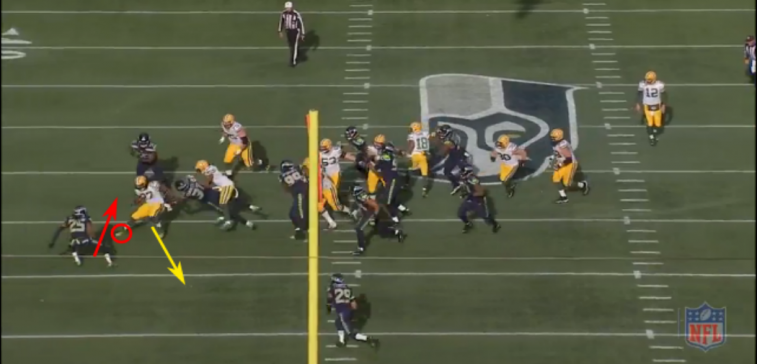
Here is Sherman’s interception. Rodgers lines up in an 11 set in shotgun with trips right and WR17 Adams alone on the right outside. Sherman plays bump-and-run coverage with Adams running a go-route to the back of the back right of the endzone. Rodgers takes the snap and scrambles around the pocket looking downfield for his wide receivers before settling on Adams. This is an awful throw. Watch Rodger’s footwork as he is releasing the football.

Rodgers’ is sliding outside throwing across his body trying to lob the ball over Sherman. This is an easy inteception for Sherman who effortlessly cuts off the ball returning it to the offense. Adams actually has a slight edge over Sherman as he is entering the endzone but that’s only because Sherman was turning to locate Rodgers and the play.

Play 6
Situation: 1st and 10 at GB 44
Description: Q1 - (3:39) (Shotgun) A.Rodgers pass short left to J.Nelson to SEA 41 for 15 yards (B.Maxwell).

Sherman lines up against Adams on the right outside and easily covers him throughout the entire play as Adams attempts to run a curl route to the outside. Seeing Rodgers scramble around the pocket, Adams attempts to run up the sideline to get open for his quarterback, but Sherman sticks to him the entire way. Great coverage.

Play 11
Situation: 2nd and 7 at SEA 30
Description: Q4 - (11:11) (Shotgun) A.Rodgers pass incomplete deep right to J.Starks.

Rodgers has trips right with Sherman playing WR87 Nelson in the slot right who runs a spot route over the middle. This route is typically run to the find the whole between two interior zones of inside linebackers, but since only one is present Nelson is covered the entire way. I wanted to show this play to show just how Sherman latches on to the player and doesn’t release from them in coverage.
Edit: Plays 11-15 were played with an injured elbow that Sherman suffered in Play 10 (on the next page).

Play 12
Situation: 3rd and 7 at SEA 30
Description: Q4 - (11:04) (Shotgun) A.Rodgers pass incomplete short left to J.Starks [B.Irvin].

Sherman lines up against WR87 Nelson on the right outside who runs a go route. Kam Chancellor is playing Cover 2 over the top to bracket cover him as well, so Nelson can’t get open. In this play, Sherman plays phyisically on Nelson almost too much as a liberal referee might have flagged this for defensive holding. Near the 20 yard line it looks like Nelson’s right arm is extending backwards getting pulled by Sherman, but that could just be them fighting each other in the route to create/diminish separation on both sides.

This article continues on the next page.

Patriots Pass Defense vs Andrew Luck (92 YDs, 0 TDs) First Half

With all the hype that came with two great Quarterbacks playing against each other in the playoffs, this game became one of the most one sided matches of the playoff season. Despite the Colts opting to drop back Andrew Luck 23 times in the first half, they only had 12 positive plays come out of it, a success rate barely passing 50% which includes two penalties. How did the Patriots do it?


Rob Ninkovich Will Break You

The Patriots were well aware of the Colts potent passing attack and had to figure out a way to keep them from being able to stretch the field, which they would try to do plenty of times in the first half calling for verticals, deep ins, posts, and corner routes. The Patriots even dared them to try by only rushing four players on each down and playing with one deep safety for a majority of the half. You know what stops deep routes from getting hit though, pressure and coverage.

If there was a game ball given for just the first half of a game, Ninkovich would be far and away the obvious candidate for the most valuable player. He managed to beat his man and force Luck to move in the pocket 8 times by my count (with some help from Chandler Jones) and bat down 2 passes in just two quarters of football. The Patriots identified that RT Joe Reitz had trouble reacting to stunts and couldn’t keep up with Ninkovich’s speed rush so they abused him with both.

On the second play of the game the Patriots line up Ninkovich as a LDT with Chandler Jones as a LEO, they use this wide formation often this game, daring the Colts to run into the big gaps with only two Linebackers out on the field. Jones will press the outside lane to get Reitz to turn his hips perpendicular to the yard line and then crash inside, Reitz will time and time again overcommit at this point and let Ninkovich just slide right by.

Here they are doing it again, this time Jones doesn’t even sell it as well but Reitz still is way late on getting around to Ninkovich. Luck completes this pass, but Ninkovich still manages to make it difficult for him in the pocket.

Later on, it’s Ninkovich doing it for Jones. Reitz just can’t do anything about it.

Then there’s the speed rush. On all of these plays below Ninkovich controls Reitz throughout the entire process. In the first he even takes the time to completely knock Fleener off his route (off screen) before rushing and still manages to pressure Luck. But that’s not even the end of Ninkovich’s dominance in the first half.

But then there’s also these:

How are you going to deal with this? Ninkovich is so well disciplined that he realizes when he can’t make the rush and still is able to make the play. That’s 10 out of 23 passing downs in the first half that Ninkovich made his presence felt.

For a deeper look at Rob Ninkovich’s Game Against the Colts, click here.


Playing Your Opponent

In the offseason the Patriots made the big move to get king of shutdown cornerbacks Darrelle Revis and the big physical cornerback Brandon Browner. These moves along with the emergence of Devin McCourty as one of the leagues best free safeties gave the very loud impression that the Patriots were about to become an (almost) exclusively Cover-1 man team and no surprise, they did. However, it wasn’t just these two FA’s who would end up making a big impact in coverage; homegrown Logan Ryan would begin to emerge as a real presence and even Kyle Arrington came out and made himself known. Belichick told them to man up and they did.

One of the more interesting parts of this half was Browner’s usage of covering only the Tight Ends and sort of doubling as an in the box safety while Revis dealt with one of Nicks or Moncrief. You would think they would put a lot more attention on someone like T.Y. Hilton but to Belichick the biggest threat on the field was Andrew Luck’s ability to go through his progressions. The best way to stifle that strength would be to force him to rush and to force the Wide Receivers to win man battles, a tactic that’s much easier said than done. What it did show was Belichick’s awareness of his own players strengths and abilities and ability to match those up with the opponents.

Already shown above in the way Belichick chose to put Ninkovich out in a LEO role in order to allow him to speed rush constantly against Reitz, he did the same with his CBs and personnel. The Patriots would use a 4-2-5 Nickel setup (4 Defensive Linemen, 2 Linebackers, and 5 Defensive Backs) for a majority of the half switching to a more traditional 3-4-4 only once the Colts reached the redzone. He knew the Colts wanted to spread the field and he didn’t want his Linebackers being tasked with covering either of the two tight ends the Colts employ.

Kyle Arrington

On the first passing play of the game, the game plan is in motion. The CBs are manned up with Arrington, the weakest of the group, on Hilton in the slot. The reason, Arrington is fast enough to keep up with Hilton and his role would be to funnel Hilton into McCourty as many times as possible. You can also see Browner on Fleener at the bottom of the screen, keeping close on a corner route.

Then you have plays like this, where Arrington is lined up against Hilton right at the line, giving him the chance to press. Can you even tell what route Hilton wanted to run? Arrington shuts down whatever he was thinking.

Devin McCourty

It helps a lot when you have someone like McCourty covering the backside, he quickly diagnoses the deep out from Allen and drops down to cover the open space. Meanwhile, everyone else is completely covered out of the play.

Then on this play McCourty quickly reacts to the vertical pick on Arrington and takes Hilton as his man.

Just Win, Baby

Another play where everyone is fully covering their man. Duron Harmon is dropping down to take out Fleeners route, while Arrington and McCourty double up on Hilton on his vertical. At the top, Logan Ryan has Wayne blanketed and is leaving him no space to work with. Even though Luck helps by throwing this ball a little too early, there’s just nothing to work with.

The same goes with these two plays. The way Belichick chose to use his personnel in this game paid off big even when he had his best corner manned up with the offenses smallest threat.


“They Just Wanted It More”

It’s not as if the Colts didn’t try to beat the Patriots man game plan, but they looked obviously like they were giving it away at some points. There were a few plays where the Colts made some real progress, getting routes that when timed together would pick off some Patriots defenders and found some soft spots in their coverages- but the miscues by Luck and Hilton and the vastly superior play by the Patriots defensive line wrecked most of the passing plays.

Andrew Luck and T.Y. Hilton

This dynamic duo haunted teams in the regular season with their ability to make any vertical play into a game ender but the Patriots suffocated Hilton and in the few situations where Hilton had the chance, Luck just couldn’t make it happen and never for the same reason twice.

On this play, Hilton’s wide open underneath and a pass ahead of him will result in a first down on 3rd and 10. Ninkovich and Jones are generating a ton of pressure, showing that the Colts offensive line was not ready for this game, and Luck ends up throwing this behind Hilton.

Then on 1st and 10 with the 13 personnel out, they catch the McCourty/Arrington duo just right with McCourty heading outside and Hilton able to bend Arrington outside as well (he takes a small subtle step outside two steps before breaking out of the vertical stem) and then goes inside for the post, but Luck misses. Luck takes a hit from Jones, but Jones never actually gets the chance to affect the throw- it’s just a miss.

Finally on this play, Luck reads the field, fakes to Nicks on the underneath route and then throws to Hilton, but when Luck fakes to Nicks, Hilton lets up on his route and slows down instead of finishing. There’s no winning for these two.


Where There’s A Will There’s A Way

Obviously we all know the outcome of this game, but at this point in the half there were still some things that the Patriots had yet to have answers to. With the Patriots committed to keeping McCourty deep, they played both Linebackers further back in the first half to stop the intermediate routes, especially on the few zone calls they had. This opened up the field to pick plays and underneaths, where the Colts did find success.

Fleener picks off and carries Wayne’s defender for at least 6 yards allowing Wayne a free path to the outside. Luck misses, but this shows that they can make this work.

Just like before where a Vertical route picked off Hilton’s defender, this time the Vertical keeps McCourty from coming over this route and allows Luck to drop a dime right on the sideline.

Finally, against a Cover-3 Zone the Colts get the Tight End on a delayed release, and Allen ends up making a wide open catch. This situation comes up a few times on delayed releases for the Colts, mostly for the Running Back.


That’s it for the first half. I’ll be putting up the next half soon, and focusing on how the Colts adjusted to try and take this game into their own hands and what the Patriots defense did to keep kicking the Colts while they were down.

Click Here For The Second Half.

Deeper Look At Every Pass Play In The Half On The Next Page

Rob Ninkovich vs Colts Cover

Rob Ninkovich vs Colts

Rob Ninkovich’s versatility in the Patriots’ modified Fairbanks-Bullough 3-4 system was demonstrated exceptionally versus the Colts. According to ProFootballFocus, Ninkovich finished the AFC Championship game with a score of +9.2 with 6.6 of his points coming from his pass rush. In this game, he totalled four tackles, two QB hits and nine QB hurries constantly making his way into the backfield while setting the edge on running plays. In this breakdown, we will look at Ninkovich’s role in this system and how he fared in all aspects of his game versus the Colts.

First, the Patriots run a modified version of the Fairbanks-Bullough 3-4 system. The original Fairbanks-Bullough system featured two gap assignments for the defensive lineman while allowing the linebackers to roam behind the larger body defensive lineman to collect tackles around the edge. The Patriots version of the system is even more flexible than the original stressing versatility in their defensive roles. In addition to the typical 3-4 roles, Belichick likes to shift defensive lineman to over and under positions creating a modified 4-3 to crowd the line of scrimmage to confuse the offense. In this defensive scheme, Ninkovich fills the role as a defensive end in the 4-3 unit, and outside linebacker in the 3-4 unit.

Click here for a breakdown of Patriots Pass Defense versus Andrew Luck.

Note: Play numbers correspond to plays featured here.

Pass Rush

At 6’2″ 260 lbs, Ninkovich is on the smaller side for a 4-3 defensive end or 3-4 outside linebacker. Traditionally, defensive ends or outside linebackers tend to be 2-4 inches taller. So what makes Ninkovich special in Belichick’s modified Fairbanks-Bullough 3-4 system? Let’s take a look at his pass rushing plays versus the Colts to determine this answer.

Play 1
Situation: 2nd and 8 at IND 23
Description: Q1 - (14:21) (Shotgun) A.Luck pass incomplete short right to D.Allen.


The Patriots line up with eight men on the line of scrimmage. This is a very confusing look for Luck. Instantly, Luck can determine that he has man-to-man coverage on the two wide receivers on the right, so the shallow cross route by the tight end is probably going to be his best bet.

The Patriots drop three off of the line of scrimmage into zone coverage and one into man-to-man coverage on TE80 Fleener. Ninkovich lines up wide left and rushes around RT76 Reitz. In this play, Ninkovich uses his speed to engage with Reitz and then dips his interior hip to turn around the blocker. Luck sees the pressure and backfoots his throw leaving the ball short of his target.

Play 2
Situation: 2nd and 8 at IND 34
Description: Q1 - (8:58) (Shotgun) A.Luck scrambles right tackle to IND 39 for 5 yards (D.Hightower). NE-D.Revis was injured during the play.


Just like Play 1, Ninkovich rushes from the left outside and uses his speed to get around the right tackle forcing Luck to step up into the pocket. Luck uses his mobility to scramble outside and for a gain of five yards on the play.

The reason why I’m showing this play is to demonstrate Ninkovich’s individual effort and pursuit. After, Luck steps up into the pocket, Ninkovich works his way all of the way back around the formation.

Most defenders at this point would just give up and stay in the backfield recovering for the next play, but Ninkovich doesn’t quit his pursuit. Just love the individual effort on this play.

Play 3
Situation: 2nd and 5 at NE 41
Description: Q1 - (6:01) A.Luck pass incomplete short right to J.Doyle (R.Ninkovich).


The Colts run a packaged play that is very common to Seahawks and the Redskins fans alike. It is a play-action bootleg right where TE84 Doyle runs across the backfield to be Luck’s first read on the play in the flat. Ninkovich first reads the interaction between Luck and the runningback to make sure it’s not a running play seeing Doyle running to the right flat.

Ninkovich chips Doyle legally, since the contact is within five yards of the line of scrimmage. A technique very common among the Patriots linebackers as seen in our Forsett vs Patriots breakdown.

This chip slows down Doyle, but also it allows Ninkovich to get in the throwing lane of Luck to swat down the ball. Excellent stop on the play and great recognition of the play design.

Play 6
Situation: 3rd and 10 at IND 33
Description: Q2 - (15:00) (Shotgun) A.Luck pass incomplete short right to T.Hilton (D.McCourty) [Cha.Jones].


Ninkovich lines up wide left and bull-rushes RT76 Reitz. This play demonstrates the power Ninkovich can develop and deliver while driving into the blocker. He also, places his hands with great technique on the inside shoulder pads of Reitz generating great leverage.

The one improvement Ninkovich should make is that after he takes his three steps towards his target, Ninkovich stutter steps. This is something that doesn’t add anything to the pass rush and gives the right tackle more time to adjust his body to attack the angle more correctly. Excellent edge rushers like Kansas City’s Justin Houston take two to three steps toward their target and commit to the move without stutter-stepping. This should help Ninkovich penetrate better in the future.

Play 10
Situation: 2nd and 10 at NE 23
Description: Q2 - (6:06) (Shotgun) A.Luck pass short left to C.Fleener ran ob at NE 12 for 11 yards [R.Ninkovich].


Ninkovich lines up wide left and speed rushes around the outside of the right tackle. Ninkovich starts more inside and then uses his arms to double-swipe away the hands of RT76 Reitz to get around him. For more details on the Double Swipe move read more in our Ryan Kerrigan - Double Swipe article. After Ninkovich makes it around the right tackle, he dips his right hip and continues to pursue Luck delivering a hit on the scrambling quarterback. Another play showing his excellent pursuit and effort.

Please continue reading on the next page.

Marshawn Lynch vs. the Packers (25 carries, 157 yards, 1 TD)

It’s no secret that Marshawn Lynch is one of the best RBs in the NFL, and all of his attributes were on display during the Seahawks’ comeback against the Green Bay Packers in the NFC Championship Game. Lynch and Russell Wilson led the Seahawks to a top ranked rushing attack in 2014 that rushed for over 400 more yards than their closest competitors.

While the Packers kept Lynch very quiet in the first half, they simply could not contain him in the second. He ran all over the defense, breaking into the secondary on multiple occasions. To do this, he used not only his incredible power as a runner but also great agility and his elite jump cut to slash the Packers’ run D. Let’s take a look at the tape to see exactly how Lynch used his moves effectively in this game:

2-5-SEA 36 (Q2, 7:45) M.Lynch left tackle to SEA 39 for 3 yards (L.Guion).

I picked this run not because it was particularly successful but rather because of the “never give up” attitude that Lynch displays at pretty much all times. Here, the Seahawks are employing their zone blocking scheme, slanting to the right. You can very clearly see the entire line shift towards the right, with the exception of the TE who pulls across the formation to seal off the backside DE.

Unfortunately for Lynch, the blocking at the point of attack is downright bad and there ends up being a blob of bodies. This forces him to cut it back. One of Lynch’s best attributes is his jump cut, and it’s on display here as he seemingly teleports about two body widths to the right on the cutback. Still, though, he runs into trouble as Clay Matthews is right in his face. While known primarily for his power running, Lynch also has great agility. He uses that agility to make Matthews and the next LB, Barrington, miss before Letroy Guion is able to drag him to the ground.

3-2-SEA 39 (Q2, 7:08) (Shotgun) M.Lynch left tackle pushed ob at GB 47 for 14 yards (S.Shields).

This play shows patience, vision, and explosion from Lynch. He gets the ball off of a read option handoff, and hesitates for just a moment. This not only allows him to find the correct hole, but also theoretically allows #77 James Carpenter to plant a block on #42 Morgan Burnett. However, Carpenter whiffs on his block. It ends up not mattering, though, because Lynch shows great burst and runs past Burnett before he can get an arm on him.

From there, Lynch has a fair amount of open space to run in. In typical Marshawn Lynch fashion, he finishes the run tough even though he goes out of bounds, lowering his shoulder into the DB and making good contact before getting carried out of bounds by his momentum.

2-2-SEA 30 (Q3, 10:18) (Shotgun) M.Lynch left tackle to SEA 41 for 11 yards (S.Richardson; L.Guion).

This is yet another run showcasing Lynch’s strength. First of all, I find the angle he takes through the hole to be perfect. If he’s further outside, AJ Hawk might have had a chance to make a play on him, but instead he ends up having to dive and flail his arms. Then, he gets stood up by three defenders and somehow still manages to pick up five extra yards despite a gang of defenders on him. This run truly shows impressive power from Lynch.

2-2-SEA 49 (Q3, 9:02) M.Lynch right tackle to GB 39 for 12 yards (L.Guion).

On this play the Seahawks are running out of 20 personnel, or 2 RBs and 0 TEs. This means they have three WRs split off the screen, and really only 6 blockers for an inside run. Fortunately, the Packers respond to the Seahawks spreading them out by only putting 6 defenders in the box, so it’s an even matchup. The Seahawks then run a zone scheme to the right, with a fullback lead. Lynch has excellent vision, and is able to find a hole between Mike Daniels and Julius Peppers. Daniels grabs his jersey, but Lynch also has excellent balance so he stays on his feet and accelerates forward. Letroy Guion failed at the point of attack and got pushed back, but he did a good job of staying with the play and he ended up making the tackle. Once Guion took out his legs, Lynch also did a great job of falling forward to maximize yardage.

2-30-SEA 41 (Q3, 7:34) (Shotgun) M.Lynch left tackle to GB 48 for 11 yards (M.Burnett).

This is after Wilson took a really long sack, so it’s second and 30. This kind of limits the options for the offense. So the Seahawks decide to go with a draw to Lynch to hopefully recover a chunk of the yards lost. He starts outside, makes a nice change of direction, and then not only drags a guy who is hanging on to his foot for a few yards before discarding him, but also continues to try to power forward for about another second before being finally thrown to the ground.

This didn’t get the Seahawks close to a first down, but it made the 3rd down situation significantly more manageable.

1-10-SEA 27 (Q4, 9:34) (Shotgun) M.Lynch right tackle to SEA 40 for 13 yards (S.Barrington).

I apologize for the skip in this one, but there’s a skip in the film which I’m getting from NFL Game Rewind. Anyway, from a read option fake Lynch presses the inside before cutting back out to split two defenders, who he leaves on the ground grasping at air. Then as he gets towards HaHa Clinton-Dix he slams right into him. That’s the kind of hit Clinton-Dix was supposed to lay on the RB, not the other way around. That just shows Lynch’s awesome physicality on the football field.

3-6-SEA 44 (Q4, 8:22) (Shotgun) M.Lynch up the middle to GB 45 for 11 yards (S.Barrington; H.Clinton-Dix).

This play once again shows the awesome power of Marshawn Lynch as a runner. The Seahawks are running an inside zone run to the left this time, and Datone Jones just embarrasses JR Sweezy. Really, this should blow the play up in the backfield because Jones has a free shot at Lynch. However, Lynch uses his awesome jump cut to get himself out of trouble by warping away from Jones’ attempt to tackle him. Jones is only able to get his arms on Lynch, who shrugs it off. After making Jones miss, Lynch runs into his own lineman but is still able to get a push even with five defenders trying to stop him (well, he did have help from his offensive lineman) and ends up with his sixth carry of over 10 yards on the day.

2-10-GB 35 (Q4, Shotgun) R.Wilson pass deep right to M.Lynch ran ob at GB 9 for 26 yards.

On this play, Lynch is running what is known as a “wheel route” where the RB runs to the sidelines outside the outermost receiver and then turns upfield. The man out wide at the top of the screen runs a curl route. This adds positively to the play on two levels. First, it gets his man, the CB, to run towards the LOS so he has to completely change direction if he wants to follow Lynch. Second, he acts as a roadblock to the LB who is in man coverage on Lynch. As you can see, the LB has to navigate around him to chase Lynch, and at that point he’d already lost. It’s not a pick play per se, but it has a similar effect. This leaves Lynch absolutely wide open, and it’s an easy decision for Wilson. Just barely stepping out of bounds is all that prevents this from being a life giving TD for the Seahawks, which they will get a few plays later.

1-10-GB 24 (Q4, 1:33) (No Huddle, Shotgun) M.Lynch left tackle for 24 yards, TOUCHDOWN.

This would be Lynch’s last long run and his most important carry on the day, as it was the go ahead TD for the Seahawks. This play is well blocked by the Seahawks. Lynch stumbles a bit going through the hole but he is able to clearly maintain balance. Then, he used his vision to first cut up inside to avoid a tackle from Micah Hyde and then he kicked it back outside to avoid Sam Shields. Once he was past those two defenders, he strolled into the endzone and put the Seahawks on top.

In his game against the Packers, Marshawn Lynch turned on Beast Mode in the second half. He had 7 carries of over 10 yards in the half and racked up over 100 yards on 16 carries. Many of the carries displayed the attributes that make him a top RB in the NFL: his power, vision, agility, and tenacity. He put the Seahawks in the lead with flair on a 24 yard TD run and was perhaps the biggest piece on offense that lead to an amazing Seahawks comeback.

Wilson vs GB NFC Conference Cover

Russell Wilson vs. Packers - 14/29, 209 yards, 1 TD, 4 INTs

Russell Wilson and the Seahawks played the Packers in the NFC Championship. This game featured an epic comeback by the Seahawks down by 19 points to beat the Green Bay Packers. The game didn’t start well for the Seahawks as Wilson threw multiple interceptions and the offensive line allowed way too much pressure. However, two last minute drives and a lucky onside kick advanced them to the Superbowl to play the New England Patriots. Let’s take a look at some of Wilson’s plays to figure out what happened in this week’s breakdown.

Stats
Wilson - 14/29, 209 yards, 7.2 ypa, 1 TD, 4 INTs, 1 Fumble, 5 sacks for 25 yards, 7 carries for 25 yards, 1 rushing TD

First let’s take a look at Wilson’s interceptions in Plays 2, 6, 10, and 29. What you’ll notice is that the Packers used the same Cover 1 Robber shell for all of these interceptions and almost had a fifth interception in Play 27.

Play 2
Situation: 3rd and 7 at SEA 23
Description: Q1 - (10:37) (Shotgun) R.Wilson pass short middle intended for J.Kearse INTERCEPTED by H.Clinton-Dix at SEA 30. H.Clinton-Dix pushed ob at SEA 4 for 26 yards (J.Sweezy). PENALTY on GB-M.Daniels, Taunting, 15 yards, enforced at SEA 4.


Offensive Formation: Empty-Set Shotgun Trips Left
Offense Personnel: 11 (Lynch is lining up as a WR on the left outside)
Defensive Formation: Cover 1 Robber, man-to-man coverage across the board

Wilson in shotgun pre-snap reads a defender directly over WR15 Kearse and a defender at the line of scrimmage over his slot right wide receiver. This same lineup is mirrored on the opposite side of the field, but the main difference is that there are three wide receivers as opposed to only two. This means that either the Packers at double-covering the slot receiver, the Packers could drop the defender in off-man coverage into zone, or they could blitz the cornerback at the line of scrimmage. The Packers choose the latter, which means that the slot receiver is against off-man coverage.

Kearse runs an in-route and it’s well covered. Maybe Wilson thought that the blitz was coming but the Packers were playing zone coverage on the right outside, but regardless he takes the snap and delivers an accurate pass to Kearse. Unfortunately due to the slipper conditions and the excellent coverage, the ball bounces off of his hands and falls right into FS21 Clinton-Dix’s hands for an interception who was playing robber over the middle of the field. Not a good start.

I don’t blame Wilson for this throw. Typically the worst case scenario for this throw is a quick incompletion and on 3rd and 7 the Seahawks were hoping this designed interference play with the slot right receiver would open up the field underneath. Good defensive call by the Packers.

Play 6
Situation: 1st and 10 at SEA 20
Description: Q2 - (9:37) R.Wilson pass deep middle intended for J.Kearse INTERCEPTED by H.Clinton-Dix at GB 32. H.Clinton-Dix to SEA 41 for 27 yards (J.Kearse). PENALTY on GB-C.Matthews, Illegal Blindside Block, 15 yards, enforced at SEA 41.


Note: The game tape was having technical difficulties for this play and for a few others, so I could only get part of the play. It should be enough to display something we noticed last week versus the Carolina Panthers.

In this play, Wilson attempts to throw the deep post route to WR15 Kearse on 1st down, but the ball is intercepted beautifully by FS21 Clinton-Dix.

Wilson attempts to look off Clinton-Dix, but he isn’t fooled, so he returns to deep safety help on Kearse. Before Wilson releases the ball, what you’ll notice is that Kearse does not have any separation on this play. CB38 Williams does an excellent job staying with Kearse the entire play, but Kearse has inside leverage over Williams. This means that if Wilson can lead Kearse and place it past Clinton-Dix it has a chance of becoming a deep play.

Unfortunately, Wilson underthrows the ball and Clinton-Dix makes an excellent one-armed interception on the ball. If you are going to miss this throw, you HAVE to throw it deep seeing as Clinton-Dix was in-front of Kearse’s path. Just like last week against the Carolina Panthers, Wilson continues to struggle with underthrowing his deep long balls.

Play 10
Situation: 3rd and 8 at GB 18
Description: Q2 - (2:00) (Shotgun) R.Wilson pass deep left intended for J.Kearse INTERCEPTED by S.Shields at GB 0. Touchback.


Offensive Formation: Empty-set Shotgun Double Wing
Offense Personnel: 11 (Lynch lines up as the left outside WR)
Defensive Formation: Cover 1 Robber, man-to-man coverage across the board

It’s 3rd and 8 with 2:00 minutes left in the first half. Wilson has WR15 Kearse in the left slot running a corner route to the endzone. The two wide receivers are running what’s a called a “Smash Concept”. Where the outside WR runs a short hitch and the slot receiver runs a corner route. This is meant to attack zone coverage, by flooding the left outside zones or to attack bump-and-run coverage on the slot receiver if the defense is in man-to-man coverage like they are in this play.

Wilson takes the snap and immediately looks for the corner route. He lobs the ball into the air trying to give Kearse a chance at the ball, but Wilson plaecs the ball too far to the inside of Kearse allowing CB37 Shields a chance at the ball. After Kearse cuts outside, you’ll notice that Shields turns his head and watches Wilson the entire play looking for the ball. This is amazing awareness and coverage.

The other option in this play would have been to go to the quick-in route on the right side of the field, but it might not have gotten the Seahawks a first down based on the underneath coverage of the safety playing robber. If Wilson wants to make this throw, he has to place it further outside to give his wide receiver a chance at the ball and make sure the defender can’t play it.

Play 27
Situation: 2nd and 15 at 50
Description: Q4 - (7:11) (Shotgun) R.Wilson pass incomplete short middle to K.Norwood (H.Clinton-Dix).


Offensive Formation: Shotgun Trips Right Near
Offense Personnel: 11
Defensive Formation: Cover 1 Robber, Man-to-man across the board

This is Wilson’s worst throw of the game. He completley doesn’t see the FS21 Clinton-Dix playing robber over the middle and forces the ball to WR81 Norwood running a dig route. Awful throw. Wilson stares down the receiver and then throws it inaccurately. This should have been Clinton-Dix’s third pick on the day.

Play 29
Situation: 1st and 10 at SEA 46
Description: Q4 - (5:13) (Shotgun) R.Wilson pass short middle intended for J.Kearse INTERCEPTED by M.Burnett at GB 39. M.Burnett to GB 43 for 4 yards. Went down on his own.


Offensive Formation: Shotgun Trips Right Near
Offense Personnel: 11
Defensive Formation: Cover 1 Robber, Man-to-man across the board

This play is almost identical to Play 27, but this time it results in an interception. In this play, Wilson targets Kearse who is in the middle of the trips right running a deep-in route over the middle of the field. Wilson takes the snap and throws a bullet right into the diving arms of Kearse who lays out for the ball. CB33 Hyde is right on the tail of Kearse. The ball was well-placed, but it again bounces off of Kearse’s hands straight into the air for SS42 Burnett to intercept it.

Breaking down Wilson’s mechanics on this play, his footwork isn’t the best as he drifts backwards as he is releasing the ball. He gets good velocity on the throw, but he needs to release this ball with more anticipation. The ball should have been released a full second earlier right as Kearse was about to start making the cut down the field, which would have given Kearse more separation on the play. Like Play 2, this is another play where you typically don’t see the ball pop straight up for the defense that usually results in an incompletion and nothing more.

Play 28
Situation: 3rd and 15 at 50
Description: Q4 - (7:07) (Shotgun) R.Wilson pass incomplete deep middle to D.Baldwin (C.Hayward) [D.Jones].


Here is one final play showing Wilson’s struggles with the Cover 1 Robber. In this play, Wilson attempts to throw deep to Baldwin when he should have thrown it to the tight end running the deep crossing route, since the safety that was sitting back there in a Cover 2 look moves up to the middle, which opens the deep left half of the field. If I were the Patriots, I’d be looking at using McCourty and Chung in Cover 1 Robber looks for the Superbowl.

Please continue reading on the next page.

Darrelle Revis vs. Colts


Darrelle Revis has long been known as a “lockdown” corner, he was one of the first CB’s to travel to either side of the field in order to defend a specific WR. But how many people have actually watched Revis’s film to study his technique, physicality and insticts that makes him so dominant. After watching the game last Sunday, a game purely dominated by Revis and the Patriots, I decided to break down the Revis tape. With only two passes thrown his way, Revis gave up no catches and had an interception on a great play.

The Patriots play mostly man-to-man coverage (Cover 1) and allow Revis to match-up with the WR of their choice in order to essentially take that WR out of the game. In order to show how Revis dominated the game, the article has been split into a man-to-man and a zone coverage section. The routes highlighted in yellow are the routes that Revis is defending on the specific play.

Let’s start out with Revis’s best play of the day; the interception in the 3rd Quarter.


3rd & 5. -40. 2:24 3rd.

Defensive Formation: Nickel

Coverage: Cover 1

Offensive Personnel: 11 Personnel

The Colts run a “pick” play with their paired WR’s at the bottom of the screen. Revis is in man-to-man coverage with the outside WR who will run a “Go” route. Since Revis is pressing the WR, he ends up jamming him into the slot CB who is covering the “Out” route going underneath the “Go”. The “pick” essentially allows Revis to look into the backfield and read the QB’s eyes and to recognize the play and where the ball could be going. Although his man continues on his “Go” route, Revis leaves his route. Because the FS is in a deep zone and shaded to Revis’s side, this allows Revis to gamble on the route combination that he recognizes. The QB throws the “Out” and since it is such a long throw, the ball is in the air for an extended period of time. This allows Revis to cut the route and the ball off in the passing lane and intercept the ball.

This is the play that defined Revis’s game and put him in the box score, but it is not the only time that he changed the game. The next page begins the breakdown with Revis’s man-to-man coverage throughout the game.


Please continue onto the next page.

Layout mode
Predefined Skins
Custom Colors
Choose your skin color
Patterns Background
Images Background