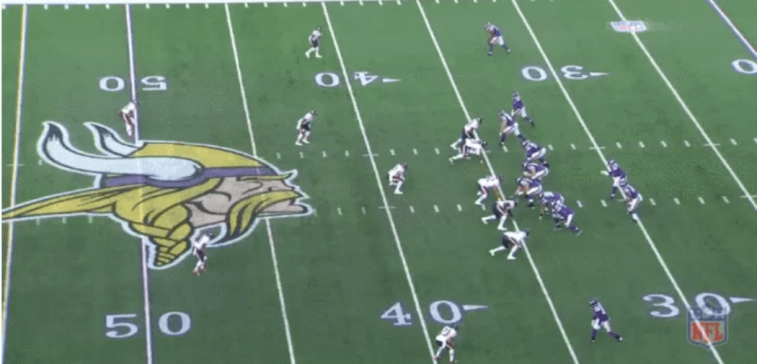

Teddy Bridgewater’s 12 Turnovers in 2014
Over my next few articles, I’m going to be covering the biggest positives (touchdowns) and negatives (turnovers) from the young QBs in 2014. This article will cover Teddy Bridgewater’s 12 interceptions in 2014, plus the three times he put the ball on the ground. First, I’m going to cover some charting data I came up with while watching his passing. Then, on page 2 and beyond, there are my thoughts on the individual plays themselves. You should note that while the section covering each individual play includes the fumbles, the charting data does not.
Here are the articles so far:
One of the first things I charted for each interception was blame. I assigned three categories, which should be self-explanatory:
Blame
| QB’s Fault | 6 |
| Partially QB’s fault | 3 |
| Not QB’s fault | 3 |
Half of Bridgewater’s interceptions were on him. I have no idea how that rate stacks up against the rest of the NFL besides Carr and Bortles (I can say that it’s a better rate than either of those two). Also, Bridgewater had three INTs that I don’t think were his fault, but rather that the blame lies elsewhere (one pass was a Hail Mary, the other two bounced off of Matt Asiata’s hands).
What caused the interceptions?
Cause
| Bad Decision | 4 |
| Bad Throw | 6 |
| Pressured | 5 |
| Great Defense | 2 |
| Dropped Pass | 3 |
| Tipped By Defense | 2 |
Since there’s overlap in these categories (you can make an ill-advised decision and still make a poor throw), these numbers do not add up to 12. From this, it looks like Bridgewater’s interceptions were slightly more due to bad throws than bad decisions, although there was definitely overlap. He was also pressured on 5 of his interceptions. Perhaps somewhat surprisingly, two of the plays where I gave Bridgewater no fault were when he was pressured, and I only marked him off for a bad decision on two of the pressured plays. That’s not necessarily an indicator that he’s usually cool under pressure, but it’s a hopeful sign.
What about distance covered? Bridgewater’s average depth of target on these throws was 16.8 yards. Where on the field was he throwing the ball? Here’s a breakdown of each throw:
Distance Breakdown
| Fewer than 6 Yards | 4 |
| Between 6 and 15 yards | 3 |
| More than 15 yards | 5 |
Location Breakdown
| Deep Left | Deep Middle | Deep Right |
| 2 | 2 | 0 |
| Intermediate Left | Intermediate Middle | Intermediate Right |
| 0 | 1 | 3 |
| Short Left | Short Middle | Short Right |
| 1 | 1 | 2 |
Bridgewater’s interceptions are pretty spread out across the field. I don’t know if there’s a discernable pattern, but there isn’t a lot of data either. One thing that kind of jumps out is the 5 interceptions to the intermediate and deep right. Looking at the numbers, that could indicate that Bridgewater either struggles with arm strength or accuracy when throwing to his right, but after looking at it on tape I don’t think that’s the case. One was a Hail Mary, one was an ill-advised desperation throw, and one was kind of a fluky play. One of them was a throw behind a receiver and the fifth throw was too late, but there was not a clear pattern with the causes of those five interceptions.
What about the time left on the clock? First, a breakdown of potential game situations, followed by a breakdown by quarter:
Situational Breakdown
| Crunch Time | 1 |
| Garbage Time | 0 |
| Desperation | 1 |
Quarter Breakdown
| 1st Quarter | 1 |
| 2nd Quarter | 7 |
| 3rd Quarter | 3 |
| 4th Quarter/Overtime | 1 |
Bridgewater did throw an interception with the game on the line. Besides that, he kept a clean slate in the 4th Quarter in 2014. We definitely see a trend here, however, and it’s with 2nd Quarter interceptions. This indicates that Bridgewater gets more reckless when he’s trying to lead the team down the field before halftime. He threw 5 interceptions with fewer than 5 minutes left in the first half. That’s nearly half of his picks. Scoring before halftime can help change the game, because it definitely helps to be up that much more (or be that much closer to the lead) getting out of halftime. Bridgewater will need to clean that up and stay focused as the half winds down.
Now let’s take a look at the interceptions he threw by down:
Down Breakdown
| 1st Down | 6 |
| 2nd Down | 3 |
| 3rd Down | 3 |
| 4th Down | 0 |
If there’s anything to take from this, I think it’s that Bridgewater might take a few more risks on first down, which seems to mesh with conventional wisdom.
What about the kinds of routes he was throwing to?
Route Breakdown
| Out | 3 |
| Checkdown | 2 |
| Vertical | 2 |
| Slant | 2 |
| Corner | 1 |
| Crossing | 1 |
| Post | 1 |
Interceptions on out routes jump out to me because those throws are probably the most physically demanding from QBs, especially when they’re deep outs. Two of those interceptions were bad ones. The fact that two checkdowns turned into interceptions is frustrating because those plays are supposed to be gimmes. However, they were because of Asiata’s stone hands, not Bridgewater’s doing.
Finally, lets take a look at who Bridgewater was targeting on his interceptions:
Receiver Breakdown
| Cordarrelle Patterson | 3 |
| Matt Asiata | 2 |
| Greg Jennings | 2 |
| Charles Johnson | 2 |
| Jairus Wright | 1 |
| Chase Ford | 1 |
| Adam Thielen | 1 |
Cordarrelle Patterson had a frustrating season and the fact that he was the target for a quarter of Bridgewater’s interceptions is also frustrating. I can’t say they were his fault (well two absolutely weren’t) but you’d like to see your young QB be able to connect with your young wide receiver and that did not happen between Teddy and Patterson. The other note I have is that I wouldn’t really include Wright on this list because the interception he was assigned as the target for was the one on the Hail Mary. But I included it because that’s what the official play-by-play did.
Since you’re probably tired of tables at this point, for the rest of the article I’m going to break down each TD pass from the film.
CLICK HERE TO READ THE NEXT PAGE OF THE ARTICLE
1-10-DET 15 (Q1, 7:42) 5-T.Bridgewater pass deep middle intended for 84-C.Patterson INTERCEPTED by 27-G.Quin at DET -2. 27-G.Quin to DET 18 for 20 yards (31-J.McKinnon).
Detroit is playing with single-high safety coverage. The route combination between Patterson and Jennings is supposed to force the deep safety (Quin) to choose to cover one of the two, and Bridgewater can hit the other for the TD. I don’t know if Bridgewater trusted his arm too much or he just failed to look Quin off, but he telegraphed the pass to Patterson and Quin (who was moving that direction at the snap) had an easy job of picking the ball off. Hitting Jennings for a TD would require a very precise throw, but he’s the best choice in this scenario (and Bridgewater, at least the version of him later in the season was money on the kind of throw he would need to make to complete it to Jennings).
3-8-MIN 42 (Q2, 14:24) (Shotgun) 5-T.Bridgewater sacked at MIN 36 for -6 yards (94-E.Ansah). FUMBLES (94-E.Ansah), recovered by MIN-71-P.Loadholt at MIN 36. 71-P.Loadholt to MIN 36 for no gain (93-G.Johnson).
This is one of Bridgewater’s three fumbles on the season. He didn’t hold on to the ball for an egregious amount of time (although it was probably a little longer than was wise), but Matt Kalil got pantsed by Ziggy Ansah. This is on Kalil. Fortunately, the Vikings recovered.
1-10-MIN 48 (Q2, :49) (Shotgun) 5-T.Bridgewater pass short middle intended for 44-M.Asiata INTERCEPTED by 59-T.Whitehead at DET 47. 59-T.Whitehead to DET 49 for 2 yards (44-M.Asiata).
Bridgewater’s checkdown pass is a little above Asiata’s head and a little to his side. It’s not the best throw. Asiata, however, should be making this catch. The INT is on him all the way. It goes right through both of his hands.
3-2-DET 46 (Q3, 11:39) 5-T.Bridgewater pass short middle intended for 84-C.Patterson INTERCEPTED by 59-T.Whitehead (52-D.Tapp) at DET 48. 59-T.Whitehead to DET 48 for no gain (74-Charlie.Johnson).
When a pass gets tipped at the LoS, it’s hard to determine whether the offensive lineman blocking the defender who tips the pass or the QB is at fault. Did Charlie Johnson allow Tapp to get in the throwing lane, or did Bridgewater choose the wrong one? I have no way to know. Since I’m sure this exact type of pass has been practiced hundreds of times by the Vikings, my inclination is to say that Bridgewater would know where the throwing lane is supposed to be and Johnson was the one who messed up. Even if Teddy did choose the wrong throwing lane, this would be just an incompletion most of the time. However, Whitehead made a nice catch. I gave Teddy partial fault on this one, but I’m not sure if I should assign any at all.
3-7-BUF 38 (Q2, 12:24) (Shotgun) 5-T.Bridgewater pass deep right intended for 86-C.Ford INTERCEPTED by 21-L.McKelvin (51-B.Spikes) at BUF 20. 21-L.McKelvin to BUF 29 for 9 yards (61-J.Berger).
This play is kind of a fluky one. Bridgewater is flushed from the pocket, and does a good job of keeping focused down the field. There is a window where Ford is definitely open, but he just misses it. Spikes, who has is back turned, makes an excellent (and kind of lucky) play to get his hand up and knock it away. It takes an unfortunate bounce for the Vikings and ends up in McKelvin’s hands. I gave Bridgewater partial fault on this one. It should be an incompletion, but the Bills got lucky that it was an interception.
1-10-MIN 12 (Q2, 9:34) 5-T.Bridgewater pass short right intended for 19-A.Thielen INTERCEPTED by 21-L.McKelvin at MIN 26. 21-L.McKelvin ran ob at MIN 26 for no gain.
This interception is Bridgewater’s fault all the way because he trusts his arm too much. Thielen could get more separation on his out route too, but the reality of this play is that Bridgewater thought he could fit the ball in to the receiver before McKelvin reached that spot and his throw was not fast enough.
2-3-CHI 29 (Q4, 1:58) (Shotgun) 5-T.Bridgewater pass deep right intended for 12-Ch.Johnson INTERCEPTED by 21-R.Mundy at CHI -7. Touchback.
With fewer than two minutes left in the game, this is a desperate throw, but the time left on the clock makes it even worse. It’s second down and Bridgewater even has enough time left to eat a sack (which is what was about to happen) rather than make this totally ill-advised throw. The Bears are in Cover 2, which means throwing to the outside receiver on a go route has little to no chance of working in the first place. Then you take into account that he just kind of launches the ball up in the air like a prayer and it looks even worse. The Vikings had time to come back. This killed that chance. He needs to be safer with it here.
1-10-MIN 22 (Q2, 7:30) 5-T.Bridgewater pass deep left intended for 15-G.Jennings INTERCEPTED by 33-M.Hyde at GB 47. 33-M.Hyde to GB 47 for no gain (15-G.Jennings).
It looks like there was some kind of mix-up with routes on this play because Jennings and Johnson are running to roughly the same spot and that should never happen. There are three DBs to two WRs and that gives the Packers an advantage. With a man in his face as he throws, Bridgewater can’t step into it and the ball is underthrown just enough for Hyde to make an athletic interception. This is a pass that never should have been attempted, and I blame the result on Bridgewater.
CLICK HERE TO READ THE NEXT PAGE OF THE ARTICLE
2-5-CAR 41 (Q2, 1:19) (Shotgun) 5-T.Bridgewater sacked at CAR 49 for -8 yards (95-C.Johnson). FUMBLES (95-C.Johnson), and recovers at CAR 49. 5-T.Bridgewater to CAR 49 for no gain (92-D.Edwards).
Mike Harris, filling in for an injured Phil Loadholt, got manhandled on this play. I don’t blame Bridgewater. Teddy falling on the ball prevented an even more disastrous result on this play.
1-10-NYJ 47 (Q2, :04) (Shotgun) 5-T.Bridgewater pass deep right intended for 17-J.Wright INTERCEPTED by 30-D.Walls at NYJ -8. Touchback.
This is a Hail Mary at the end of the 2nd Quarter. The throw is exactly what it was supposed to be. Not Teddy’s fault (note: this is the one throw I have labeled as “Desperation”).
3-8-DET 48 (Q2, 4:40) (Shotgun) 5-T.Bridgewater pass short right intended for 12-Ch.Johnson INTERCEPTED by 27-G.Quin at DET 33. 27-G.Quin to MIN 11 for 56 yards (44-M.Asiata).
This is another simple play to diagnose. It’s just an overthrow. Purely Teddy’s fault; the pass just sailed on him.
2-6-MIN 24 (Q2, 3:06) 5-T.Bridgewater pass short right intended for 15-G.Jennings INTERCEPTED by 23-D.Slay at MIN 34. 23-D.Slay to MIN 32 for 2 yards (15-G.Jennings).
Jennings is running an out route, and actually gets in really good position along the sideline. Bridgewater’s throw is just behind him. What should have been an easy first down turned into a really good scoring opportunity for the Lions. I should mention that Slay did make a very nice play to catch this ball.
2-8-DET 8 (Q4, 9:18) (Shotgun) 5-T.Bridgewater sacked at DET 18 for -10 yards (91-J.Jones). FUMBLES (91-J.Jones) (91-J.Jones), recovered by MIN-79-M.Harris at DET 18. 79-M.Harris to DET 18 for no gain (91-J.Jones).
Mike Harris wasn’t particularly good last year. I guess you’d like to see Teddy be able to hold onto the ball here but that’s got to be nearly impossible when a defender gets his hand in the right place to punch it out, so I don’t blame him. At least Harris is able to salvage the play by recovering the football.
1-10-MIA 34 (Q3, 3:48) 5-T.Bridgewater pass short middle intended for 44-M.Asiata INTERCEPTED by 79-D.Shelby (50-O.Vernon) at MIA 34. 79-D.Shelby to MIA 36 for 2 yards (79-M.Harris).
This play is totally Asiata’s fault and it really frustrated me as a Vikings’ fan because the Dolphins game was really close and this was one of a few plays that tilted the game in Miami’s favor, and it should have just been a simple play. But it bounce off of Asiata’s hands and went flying in the air and the Dolphins came down with it. It’s not Teddy’s fault in the slightest.
2-10-MIN 35 (Q3, 14:53) (Shotgun) 5-T.Bridgewater pass short left intended for 84-C.Patterson INTERCEPTED by 23-K.Fuller at MIN 40. 23-K.Fuller to MIN 9 for 31 yards (5-T.Bridgewater).
Patterson is running a slant and Bridgewater throws the ball behind him. It’s not a bad decision; the throw is just too far behind the receiver. It should be noted that Bridgewater probably noticed the charging safety and was trying to prevent Patterson from getting killed. However, the throw should still be hitting Patterson in the body. It’s unreasonable to expect him to make this catch, and it bounces off of his hand into Fuller’s. I don’t give Bridgewater total blame on this because it’s still possible for Patterson to make this catch, but he is unable to.
Teddy Bridgewater had a pretty solid rookie season, and showed a lot of promise, but also showed faults. These are some of his biggest mistakes. In the plays above, you see a few things he needs to work on. Mentally, there were times where he threw into tight coverage and paid for it. There were also a couple of underthrows. No QB is perfect, and they all make mistakes from time to time. Bridgewater is no different. These 12 plays are probably among the ones he has watched the most this offseason, and time will tell if he can learn from his mistakes and become a better player.
Click here for all of Teddy Bridgewater’s plays in the GIF Database.
Tweet
Share
Film Breakdown, Football Breakdowns, INT, Interceptions, Minnesota Vikings, QB, Quarterback, Teddy Bridgewater
About The Author
