
How the Broncos Shut Down Jonathan Stewart and the Panthers’ Run Game
The Denver Broncos’ defense dominated the Carolina Panthers in the Super Bowl. Before the big game, the Panthers had lost just one game all season. In that game, week 16 against the Atlanta Falcons, they rushed the ball 20 times. It was their lowest total of the season by nine attempts (as a team they had 27 rushing attempts in Super Bowl 50). Only five other teams even averaged 29 attempts/game last year, but Carolina hit that mark in all but one game. The Panthers also have a poor group of WRs that struggle to create separation on their own accord. A successful run game with Cam Newton and Jonathan Stewart forced the defense to move extra guys down into the box opens up the passing game. It’s cliche, but it’s also how the Panthers operated this season.
Therefore, the path to victory was pretty clear for the Broncos. If their run defense was able to shut down the Panthers’ run game, they would probably be able to shut down the Panthers’ offense. The problem with that was just how adept the Panthers were at running the football. Cam Newton adds an entirely new dimension, because he forces you to account for him not only on option plays, but on designed power runs. Combine that with the option game Carolina has and Newton, Jonathan Stewart (or Fozzy Whittaker, who spells Stewart), and Mike Tolbert give the Panthers three legitimate running threats from the backfield. Football is a game of numbers. Normally, on run plays, the defense has to account for 10 players because the QB is not a run threat. Cam changes those numbers by being a legitimate threat to run the ball. It forces multiple defenders to win one-on-one battles on the defensive side of the ball.
For how good the Panthers were running the ball against the rest of the NFL this year, they hardly had any success against the Broncos. In 26 designed runs (Cam had one scramble), the Panthers gained 3 or fewer yards 17 times. One of those plays was the Panthers’ lone TD on the day, and one put them in a 3rd and 1 situation, but that leaves 15 runs that were totally unsuccessful. That also meant that the Broncos defense consistently forced 3rd and long situations. The Panthers were forced to pass, and were ineffective when trying to do so. Because of this, they went just 3-for-15 on third down in the game, passing on 14 of those 15 attempts.
So, how did the Broncos shut down Carolina’s prolific run game? By maintaining gap integrity and their interior defensive players winning one-on-one blocks. Diving into the tape shows this:
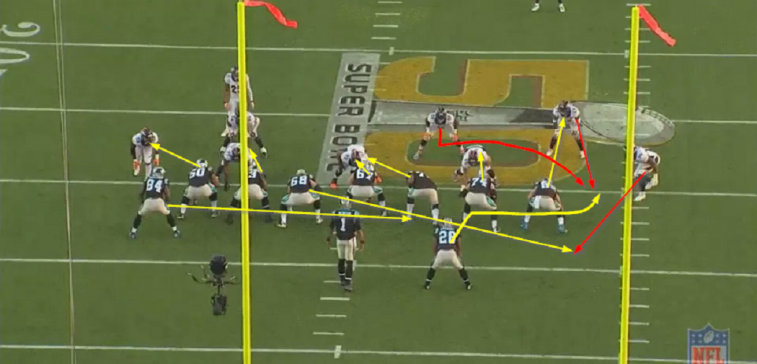
1-10-CAR 19 (Q1, 10:36) (Shotgun) 28-J.Stewart right end to CAR 21 for 2 yards (59-D.Trevathan).
The Panthers start off the game with heavy personnel. They have three TEs (including a 6th offensive lineman) and just one WR, who is off the screen. This forces 9 in the box from the Broncos. The Panthers are running a trap play, which is a counter with a guard pulling, and they also pull TE Ed Dickson across the formation to be the lead blocker. The read Stewart has to make on this play is on RT Mike Remmers, #74. He’s blocking #95 Derek Wolfe. Wolfe not only holds his ground against Remmers, but succeeds in knocking him back a bit as well. Wolfe is positioned slightly to the inside of Remmers, and, when Stewart makes his decision, LB Danny Trevathan is inside the RT as well. This forces Stewart to bounce it to the outside even though Ed Dickson is pulling through that hole. Trevathan does a great job of reading Stewart, then following him to the outside and using Wolfe’s body as a shield against Dickson. TJ Ward, who was functionally playing Will LB on this play, should also be commended for defeating Greg Olsen‘s block and being there to help Trevathan bring Stewart to the ground.
2-10-CAR 15 (Q1, 7:16) (Shotgun) 28-J.Stewart up the middle to CAR 15 for no gain (95-D.Wolfe). CAR-28-J.Stewart was injured during the play.
The setup here is different. The Panthers’ use Corey Brown in a fly sweep motion, and also give a read option look off of that. the goal here is to get the Broncos edge defender on that side, Von Miller, to freeze. It works. Miller is taken out of the play, and this puts the defense in a bad spot. The Panthers have one-on-one blocking matchups up front. The blocking on the play is inside zone. Initially, the blocking looks successful. Both Mike Remmers and RG Trai Turner do a very good job of giving a hand to assist with the down linemen and moving on to the second level. The problem is with the players they leave at that level. Derek Wolfe successfully gets off of Greg Olsen’s block, and makes the tackle for no gain. It’s a great play by him. Throughout the game, the Broncos defense had a common thread of being able to get multiple defenders to win their blocks, and that also happens here. Even if Wolfe hadn’t won so thoroughly against Olsen, this play was in trouble because Vance Walker dominated C Ryan Kalil, dragging him toward the ball carrier. What looked like an open hole when Turner and Remmers move to the second level collapsed quickly, and Stewart had nowhere to go.
1-10-CAR 21 (Q1, 6:21) (Shotgun) 43-F.Whittaker left end pushed ob at CAR 36 for 15 yards (43-T.Ward).
Despite their frequent failures, the Panthers did have a level of success against the Broncos, with 6 rushing plays of 10 or more yards. That speak less to the quality of the Broncos’ defense and more to the quality of the Panthers’ offense, because they just have too many weapons in the backfield to be stopped for 60 minutes straight. This is a triple option play from the Panthers. Newton has the ability to hand the ball off to Tolbert, keep it himself, or toss to Whittaker. Both #48 Shaq Barrett and #26 Darrian Stewart bite a little on the dive, and it forces them closer to the middle. It also means neither will have the speed to catch Whittaker on the edge. Newton takes a couple of steps to draw the defenders closer to him, then pitches to Whittaker, who has a lot of green in front of him and picks up a big chunk. Another interesting wrinkle on the play is that the Panthers are using a “tackle over” formation, as they put Michael Oher on the right side of the formation. This forced the Broncos to have their defensive line shift to the right.
1-10-CAR 36 (Q1, 5:56) (Shotgun) 35-M.Tolbert left guard to CAR 38 for 2 yards (56-S.Ray). FUMBLES (56-S.Ray), and recovers at CAR 38. 35-M.Tolbert to CAR 38 for no gain (56-S.Ray).
The Panthers ran the very next play out of a similar formation, except they’re not in tackle-over. This allowed the Broncos to move back to their base defense. It also put Darian Stewart back as a deep safety, instead of having him patrol near the box. If you watch Stewart closely, you can see he clearly has the pitch in mind as he follows Whittaker just as they both go off the screen. Unlike last time, Cam hands it off on the dive here. This is probably the correct decision. Initially, Shane Ray stays put to protect against the potential of Cam running. However, a failure along the offensive line kills this play. Ryan Kalil is initially double teaming Sylvester Williams with Trai Turner, but it he gets too invested in his block. He should move on to the second level of the defense to block #54 Brandon Marshall. Instead, Marshall attacks and gets past Kalil, forcing Tolbert to redirect his run. LG Andrew Norwell actually had to end up abandoning his double team on Malik Jackson in order to go after Marshall. This meant Tolbets’ cut was right into the waiting arms of Jackson and Ray. Ray ripped the ball out, and although Tolbert was able to get it back, this play was a win for the Broncos’ defense.
1-10-CAR 45 (Q1, 4:38) 43-F.Whittaker up the middle to CAR 46 for 1 yard (97-M.Jackson).
The Panthers fail on this play because of Michael Oher. He and Norwell are the blockers at the point of attack, and their job is to double team Jackson, while eventually one of them should move on to the second level. Michael Oher has a couple of issues on this play that lead to Jackson being free. First, he losing his footing off the snap. He’s trying to drive with his outside foot, but it slips out from under him. This makes him slow to reach Jackson. In fact, by the time he’s contacted the defender Norwell is already moving on to the second level. Oher then tries to move to the second level as well, which leaves Jackson free to make the tackle. From the perspective of the Broncos’ defense, Malik should definitely be commended on this play. You’ll note that he drops to one knee and twists his body at the snap. The Broncos play a one gap, penetrating defense, so his intent is to get in the gap between Oher and Norwell. Turning like this minimizes the contact area the offensive players can have, and facilitates his ability to move past them. In a traditional 3-4, you’d see a defensive lineman try to dig in, stand his ground, and occupy two blockers to allow the LBs a clear path to clean up. This is a different approach, but it’s just as effective.
1-10-CAR 27 (Q1, 1:15) (Shotgun) 28-J.Stewart left guard to CAR 27 for no gain (97-M.Jackson).
This is another read option play. From the broadcast angle, it’s clear that Cam in indecisive about whether or not to havnd the ball off. He holds the ball a bit too long, and Steewart doesn’t get a sure handle on it. So, this play was almost a disaster from the start, and it doesn’t get any better. Both Malik Jackson and Derek Wolfe win their individual blocks. Jackson gets the tackle credit (and was the player to touch Stewart down), but Wolfe made the play. He totally ragdolls Remmers on the play, first forcing him too far inside and then basically just throwing him off him when Remmers tries to recover to the outside. Stewarts’ feet get tangled up with Remmers’, and the RB falls down. This play was a disaster from the start for the Panthers, and they can probably actually consider a gain of zero almost a win compared to the alternatives.
Article continues on the next page!
2-11-CAR 46 (Q2, 15:00) (Shotgun) 1-C.Newton scrambles left tackle to DEN 43 for 11 yards (43-T.Ward).
This was scored as a “scramble.” It’s not. It’s a designed QB draw. This is clear because every eligible receiver starts blocking at the snap. However, the threat of a pass is also important to the success of the play. The pass action opens the running lane for Cam. First, it is clear that Shane Ray goes into his pass rush, which is a speed rush around the edge. Secondly, and this is less obvious but actually more important, the Broncos are playing man coverage on defense here. Trevathan is assigned to Mike Tolbert. The pass action with Tolbert running across the formation causes Trevathan to take steps after him. Had this been a zone defense, the running lane wouldn’t have existed because Trevathan would have just dropped into the zone and been able to react to the play. Instead, Newton has a lot of room to work with and picks up a first down.
2-3-DEN 36 (Q2, 13:17) (Shotgun) 28-J.Stewart up the middle to DEN 34 for 2 yards (95-D.Wolfe, 59-D.Trevathan).
This is another inside zone run. This is another failure of blocking up front by the Panthers’ offensive interior. First, LG Andrew Norwell fails on his block against Malik Jackson. Jackson rips, gets Norwell totally off balance, flashes in front of Stewart, and gets his arms around his legs. Stewart may have been able to power through, but his hole closes quick as Trevathan sidesteps Kalil to meet Stewart. Vance Walker also twisted to take out Stewart’s legs, and Wolfe got in on the pile too. The Broncos’ DL won across the board here.
1-1-DEN 1 (Q2, 11:28) 28-J.Stewart left guard for 1 yard, TOUCHDOWN.
On these short goal line situations, the goal for the offensive line is to chop down the defensive line and get in the way of the LBs to allow the RB to jump over top of them. The Panthers do this, and Stewart gets great elevation on his jump for the TD.
1-10-CAR 49 (Q2, 10:46) (Shotgun) 28-J.Stewart up the middle to DEN 49 for 2 yards (97-M.Jackson, 59-D.Trevathan).
This play is won by Malik Jackson. He simply controls Oher, is able to drag him to the inside, and get his arm on Stewart to slow him down. Great support by the LBs as well to finish off the tackle.
2-10-CAR 20 (Q2, 6:55) (Shotgun) 1-C.Newton left guard to CAR 34 for 14 yards (58-V.Miller, 43-T.Ward). PENALTY on DEN-97-M.Jackson, Unnecessary Roughness, 15 yards, enforced at CAR 34.
Cam Newton was by far the Panthers’ most successful runner on the day. His six runs yielding 45 yards, almost 8 per carry. He was the Panthers’ leading rusher. In the modern NFL, when we think of QBs running, the read option comes to mind immediately. Newton is much more than just an option runner, but this is a read option play. The thing is, the normal roles of the QB and RB are reversed. Newton has the dive, and Whittaker has the sweep. Because Ray defends against the sweep, Newton keeps the ball. This time, a double team on Jackson by Norwell/Oher is effective, and Trai Turner pulls and seals off Trevathan. This leaves Cam with a nice hole to run through and he picks up 14.
1-10-CAR 49 (Q2, 6:39) (Shotgun) 35-M.Tolbert right tackle to DEN 40 for 11 yards (26-D.Stewart). FUMBLES (26-D.Stewart), RECOVERED by DEN-59-D.Trevathan at DEN 40.
Remember this play? It’s the same triple option tackle-over play that Whittaker got 15 on earlier in the game. Well, kind of.This time, Norwell pulls and Newton hands off to Tolbert, and the play works just as well as it did last time. Tolbert has a huge hole and runs for 11 yards before being contacted. That’s great, right? Well, not really. Because that contact was Darian Stewart’s helmet to the ball. When a defender gets his helmet on the ball, it’s pretty hard to hold on to. Tolbert fumbles for the second time in the game, and the Broncos recover. What would have been a nice pickup to get the Panthers into scoring range turned into a turnover.
2-10-CAR 39 (Q2, 4:16) (Shotgun) 43-F.Whittaker right tackle to CAR 39 for no gain (92-S.Williams; 95-D.Wolfe).
Here, the Panthers try a toss sweep. They pull Kalil and Remmers, with the intent of having a convoy to block for Whittaker along the edge. DeMarcus Ware does a good job of setting the edge, which forces Whittaker to look inside, but I think the play mainly fails because Whittaker makes a poor decision. There is a hole for him to run through on the front side of the play, although Aqib Talib is in it. As an RB, you need to be able to beat a CB in the hole. Whittaker needs to take that. Instead, he tries to cut the run back, which defeats the purpose of his linemen’s blocks. They are trying to seal off the hole, and when Whittaker cuts back it allows Williams and Wolfe to disengage from their blocks easily to make the tackle.
1-10-CAR 19 (Q2, 1:55) (Shotgun) 1-C.Newton scrambles right tackle to CAR 22 for 3 yards (25-C.Harris).
This is another QB Draw. Like we saw earlier, the pass action drew the edge rusher (this time DeMarcus Ware) upfield. THe double team on Wolfe isn’t as successful as the one of Jackson was earlier, but it still allowed Cam to get the edge. Bradley Roby came up to support, and then Chris Harris Jr. beat Brown’s block. He was the one to take Newton down before he could reach the edge, and minimized the gain.
3-2-CAR 49 (Q2, :23) (No Huddle, Shotgun) 1-C.Newton right guard to DEN 45 for 6 yards (20-J.Bush, 43-T.Ward).
This is the play that makes Cam more difficult to defend as a runner than any other QB in the league. This is QB Power. It’s the traditional power run, with the guard pulling and a fullback (Whittaker in this case) as the lead blocker through the hole. This is a bread and butter running play for man blocking offenses. The difference is they’re normally handing it off to a RB. Cam running gives the offense one more player than it would normally have, and the threat of a pass keeps the defense in check, so it’s not like the Wildcat where the defense can sell out against the run. It’s third and 2, and the Panthers just need a first down here. Running is kind of a questionable clock management decision, but they did a have a timeout left. Cam gets the first down with ease. Olsen didn’t do a great job of blocking Barrett, who helped make the tackle, but the Panthers achieved their goal here.
Article continues on the next page!
1-10-CAR 20 (Q3, 15:00) (Shotgun) 28-J.Stewart left guard to CAR 20 for no gain (94-D.Ware, 59-D.Trevathan).
This is another read option play. Ware gets the tackle. Newton makes the correct decision to hand off, as the threat of the option held Ware initially. Honestly, Ware shouldn’t have been able to make this play. Why was he able to? Malik Jackson. While the design is to have Stewart cut back, he cuts it back to soon. The problem is, Jackson split the double team again. Stewart doesn’t want to run into the back of his own man, and Ware was able to slide over enough to defend against the cutback and make the tackle.
2-10-DEN 35 (Q3, 13:34) 43-F.Whittaker right tackle to DEN 25 for 10 yards (25-C.Harris, 54-B.Marshall). PENALTY on CAR-70-T.Turner, Unnecessary Roughness, 15 yards, enforced between downs.
This is a FB lead. It’s very well blocked by the Panthers. The double team by Kalil and Norwell works, Turner and Remmers are able to kick out their men, and Tolbert seals Trevathan in the hole. The sweep action by Cotchery held the backside LB. Whittaker gains 10 yards off this play. However, Turner then makes a mistake and decks Antonio Smith after the play is over, putting the Panthers back 15 yards for a net loss of five.
1-10-DEN 40 (Q3, 13:05) 35-M.Tolbert up the middle to DEN 39 for 1 yard (97-M.Jackson, 96-V.Walker).
This is inside zone. The Broncos’ DL creates a pile of bodies where Tolbert tries to run, and he gets basically nothing.
1-10-DEN 25 (Q3, 11:46) (Shotgun) 1-C.Newton left guard to DEN 26 for -1 yards (97-M.Jackson, 94-D.Ware).
This is a read option similar to the one Cam picked up 14 on earlier. The fake freezes Miller, but Cam chose the wrong hole to run through. Oher has been beaten by Jackson, but he has the inside. If Cam chooses to run between Oher and Norwell, assuming he can fit through the hole, he has a lot of green grass in front of him. Instead, he chooses to run right at Jackson’s gap, and the play has no chance. Jackson physically dominated Oher and did a fine job on this play, but Cam also made the wrong choice.
2-6-DEN 34 (Q3, 6:49) 28-J.Stewart right end to DEN 28 for 6 yards (52-C.Nelson).
This play is inside zone with a pulling block by Jericho Cotchery. Stewart is initially looking to run up the gut, but the Broncos’ DL creates a mass of bodies in the middle with little room to run through. Therefore, he decides to bounce it outside. No one has set the edge, and Stewart is able to use his forward momentum to pick up 6 yards and a first down.
1-10-CAR 19 (Q3, 3:12) (Shotgun) 28-J.Stewart right tackle to CAR 19 for no gain (95-D.Wolfe).
Just like the fourth run play of the game, Ryan Kalil was late getting to the second level off of his combo block. He doesn’t reach Marshall in time, and it forces Stewart to bounce the play outside again. There he was met by Derek Wolfe who did a strong job of coming off of Remmers’ block.
Article continues on the next page!
1-10-DEN 34 (Q4, 12:43) 28-J.Stewart left tackle to DEN 22 for 12 yards (94-D.Ware; 54-B.Marshall).
This is a power run. The Panthers actually give Stewart three lead blockers, with Tolbert, Dickson, and Turner all blocking at the point of attack. They have so much help that even though turner slips and is useless, there’s a wide hole for the RB on the play. Stewart gets into the second level untouched and picks up 12.
1-10-DEN 22 (Q4, 12:16) (No Huddle) 28-J.Stewart left guard to DEN 19 for 3 yards (92-S.Williams).
This sure looks a lot like the play the Panthers just ran. Their hope is to get the Broncos to overcompensate and win up the middle. While last time the intended gap was off tackle, this time it’s up the gut. The problem the play runs into is that Sylvester Williams out-muscles Kalil, and gets an arm on the back. Dickson also runs into his own man instead of blocking through the hole and clearing out Marshall, who helps with cleanup.
2-7-DEN 19 (Q4, 11:31) 35-M.Tolbert right guard to DEN 16 for 3 yards (96-V.Walker, 59-D.Trevathan).
This play is a counter run. The Panthers’ blockers once again fail at the point of attack. Walker beats Remmers and Trevathan beats Dickson, who was the lead blocker. Tolbert was able to get three, but good blocking could have sprung him to the second level.
1-10-CAR 28 (Q4, 9:00) 28-J.Stewart right tackle to CAR 29 for 1 yard (54-B.Marshall).
Sylvester Williams makes this play. The Panthers pull Kalil to lead block and leave guards Turner and Chris Scott (who was in for Norwell at this point) to double team Williams. Sly gets driven back a little, but he occupies their blocks. This is important because neither got to the second level to block Marshall, who chased the play down from the back side and made the stop for minimal gain.
The Denver Broncos were about as successful as anyone in shutting down the Carolina Panthers’ run game. Their success forced the Panthers into numerous third-ad-long situations, where their pass rush and excellent secondary stifled Cam Newton. The Broncos were able to stop the Panthers’ run game because they consistently had multiple defenders beat their blocks. The Broncos’ LBs were active in pursuit of the run, and the Panthers had some miscues when blocking. The Panthers were able to have some successes, but they came few and far between with many bad runs mixed in. It’s often said that the game is won in the trenches, and the Broncos’ dominating defensive line spearheaded their Super Bowl 50 victory.
If you liked our work, please do us a favor and Like us on Facebook and Follow us on Twitter.
Cam Newton, Carolina Panthers, Denver Broncos, Derek Wolfe, Film Breakdowns, Football Breakdowns, Jonathan Stewart, Malik Jackson, NFL Breakdowns, Run Defense, Super Bowl 50
About The Author
