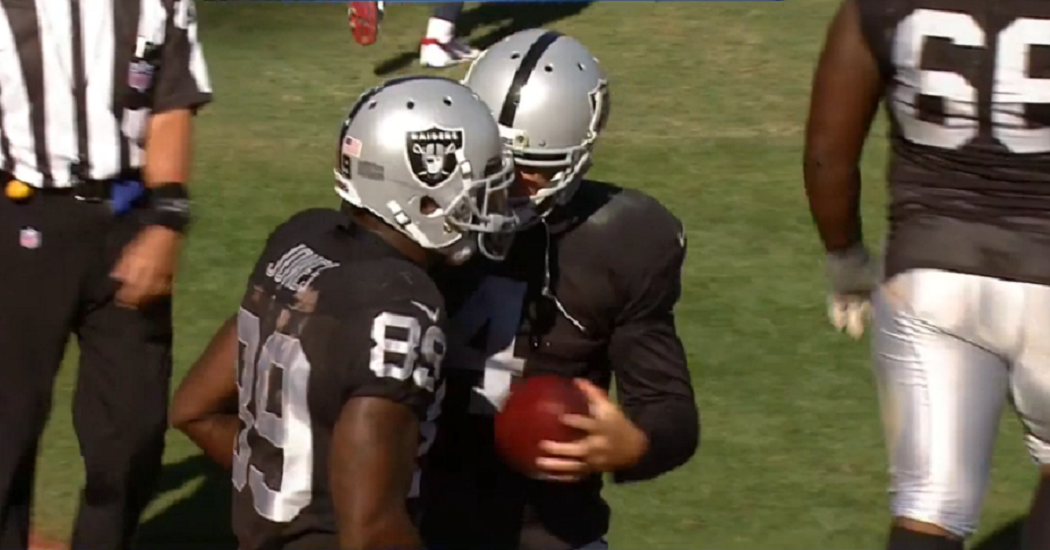
While he was the third QB drafted in 2014, Derek Carr was the first to start. He started all 16 games for the Raiders in 2014 and led a very bad team to three wins. While he wasn’t the most efficient, there were quite a few positives to take away from his play and many people are hopeful that he can turn into the franchise QB the Raiders have been missing for a long time.
Over my next few articles, I’m going to be covering the biggest positives (touchdowns) and negatives (turnovers) from the young QBs in 2014. Derek Carr leads off with his 21 passing TDs in 2014 (he didn’t have any rushing TDs). First, I’m going to cover some charting data I came up with while watching his passing. Then, on page 2 and beyond, there are my thoughts of the individual plays themselves.
Here’s data on the yardage from Carr’s TDs:
Yardage Breakdown
| Yards | 257 | Average | 12.2 |
| Yards after catch | 123 | Average | 5.9 |
| Yards in Air | 134 | Average | 6.4 |
| Yards in Air+ | 200 | Average | 9.5 |
The difference between “Yards in Air” and “Yards in Air+” is that I give credit for yards in the endzone in “Yards in Air+.” So, if the line of scrimmage is the 2 and he throws a TD pass that’s caught 7 yards into the endzone, the YIA for that play is 2 while the YIA+ is 9.
Carr averaged 9.4 yards/completion in 2014, but you would expect that to be increased with TDs passes. He threw three TDs of 30 yards or more, which really boosted his average because he only threw 5 TDs total over 10 yards. The YAC category is also bolstered by those long plays, as his two longest TD passes (77 and 47 yards), combined for 89 yards after the catch. Finally, you can see that there’s a large discrepancy between his YIA and his YIA+. This is because he threw the ball into the endzone on 14 of his 21 TD passes, and threw it at least 5 yards deep in the endzone 9 times.
This brings me to the next tables, which break his TD passes down by distance and location:
Distance Breakdown
| Fewer than 6 Yards | 10 |
| Between 6 and 15 yards | 7 |
| More than 15 yards | 4 |
Location Breakdown
| Deep Left | Deep Middle | Deep Right |
| 1 | 3 | 1 |
| Intermediate Left | Intermediate Middle | Intermediate Right |
| 2 | 3 | 3 |
| Short Left | Short Middle | Short Right |
| 6 | 1 | 1 |
The closer you are to the endzone, the more likely you are to score. As I mentioned above, all but 5 of Carr’s 21 TDs were on plays that started within 10 yards of the endzone. So, it makes a lot of sense the distribution of distances makes sense. When looking at the throw location data, you can see a couple of patterns. First, almost all of his short throws were to the left. Most of those throws were screens or flat routes. We’re working with small sample sizes, but he was successful going toward the deep middle rather than to either side, with three TDs on throws that were deep middle but only one on either side.
Now let’s take a look at the route types he threw to:
Route Breakdown
| Flat/Screen | 5 |
| Vertical | 5 |
| Crossing | 3 |
| Curl | 2 |
| Corner | 2 |
| Double Move | 2 |
| Post | 1 |
| Slant | 1 |
Note that I included goal line fades into the “Vertical” category along with go routes. It should probably also be noted that the crossing and corner routes essentially served the same purpose because they were the receivers in the back of the endzone on rollouts. On the double moves the CBs got burned badly by the route runner.
Speaking of rollouts, I also tracked plays where Carr was pressured or didn’t have a standard dropback:
Dropback Breakdown
| Nothing Unusual | 13 |
| Rollout | 6 |
| Pressured | 3 |
Note: Doesn’t add up to 21 because he was pressured on one of his rollouts.
Like most NFL teams, the Raiders liked to employ the rollout near the goal line. It seems like they were pretty successful. Carr wasn’t pressured very often on his TD passes, but that makes sense, because you’re less likely to have a successful play like a TD when you are pressured.
Speaking of pressure, how did Carr do in close moments? Here’s a look at his TD’s in “Crunch Time” (which I define as the game being within 8 points in either direction with less than 5 minutes left in the game) and “Garbage Time” (down 9 points or more with under two minutes left, 16 points or more with under 6 minutes left, or 21 points or in the 4th Quarter) TDs:
Situational Breakdown
| Crunch Time | 2 |
| Garbage Time | 6 |
Unfortunately for Raiders fans, there weren’t a lot of close games for the team in 2014. In two of their wins, however, Carr came up big. He threw TDs in the final three minutes in both the first Chiefs’ and the Bills’ game. The TD against the Chiefs gave them the lead and directly led to Carr’s first career win. The TD against the Bills extended the Raiders’ lead, and while the Bills scored another TD with time running out, they could not recover the deficit.
Looking at the garbage time TDs, I found something that astounded me. All 6 of those TD passes came with fewer than 2 minutes left in the game. When I noticed this trend, I wanted to find out just how much of an anomaly it was. I used the “Game Play Finder” tool at Pro-Football-Reference to look this up, here’s the data for 2014. As you can see, Carr has 6 and the next player has just 2. In fact, Carr makes up just over 1/3rd of these plays on the season. However, I went further to see how Carr’s season ranked all-time. PFR has play-by-play data back to 1998, and no player other than Carr has had more than 3 of these TDs in a single season. If you look at career data, you’ll see that Carr now ranks t-6th all-time despite only playing one season. If he has just two more of these types of passes, he will be second all-time to only Drew Brees, who is far and away the leader with 8 (Peyton Manning, despite playing all but 16 games for his teams since 1998, only has five). It’s, in my opinion, an interesting statistical anomaly, but there might not be much more to it.
With this talk of crunch time and garbage time TDs, let’s look at his TD breakdown by Quarter:
Quarter Breakdown
| 1st Quarter | 3 |
| 2nd Quarter | 4 |
| 3rd Quarter | 4 |
| 4th Quarter | 10 |
Down Breakdown
| 1st Down | 5 |
| 2nd Down | 4 |
| 3rd Down | 11 |
| 4th Down | 1 |
I covered part of the reason for the 10 4th Quarter TDs above — Carr was really good at throwing TDs that didn’t matter in the last two minutes of games (which doesn’t necessarily mean he’s bad at throwing TDs at other times in the game). Something else that’s interesting to note is that 3 of his first 5 TDs were in the first quarter, but he didn’t throw a first quarter TD after the Chargers game in week 5.
Carr also got it done often on third down. The majority of his TD passes came when he needed to get it on that play or settle for a field goal. Being more effective in those scenarios is definitely a good sign. His lone 4th down TD came from 1 yard out against the Seahawks.
Receiver Breakdown
| James Jones | 6 |
| Mychal Rivera | 4 |
| Andre Holmes | 3 |
| Jamize Olawale | 2 |
| Brice Butler | 2 |
| Marcel Reece | 1 |
| Rod Streater | 1 |
| Brian Leonhardt | 1 |
| Donald Penn | 1 |
Carr will be without Jones, his top target in 2015, during his sophomore season. But the Raiders added other weapons for Carr so hopefully he won’t be missed all that much. The Raiders receiving corps looks a lot better on paper than it did last year, at the very least.