
Eli Manning’s 14 Interceptions in 2015
Eli Manning threw 14 interceptions during the 2015 season. Forcing footballs and inaccuracy accounted for the majority of his errors. This analysis, similar to my “35 touchdowns” article, looks at these fourteen plays and analyzes them to see how he can improve going into the 2016 season.
Before I begin, this article is split into two pages. The first page is a detailed stat breakdown. The second page is a closer look at some of his interceptions using All-22 film.
Please take a look at the other articles I have written about him during the 2015 season, the New York Giants, or his touchdowns and interceptions from the 2014 season.
Interceptions by Distance
First, we will take a look at his interceptions by distance. Note: This chart is created by my tracking of the distance from the line of scrimmage to the actual interception location and should relate directly to the following table.
| Deep (16+ yards) | 3 |
| Medium (6-15 yards) | 5 |
| Short (0-5 yards) | 6 |
Interception Location
The next table breaks down more accurately where the ball was thrown using the same yardage designations as above.
| Deep Left | Deep Middle | Deep Right |
| 1 | 0 | 2 |
| Medium Left | Medium Middle | Medium Right |
| 2 | 1 | 2 |
| Short Left | Short Middle | Short Right |
| 3 | 1 | 2 |
Interceptions by Quarter
The following table breaks down his interceptions by quarter.
| 1st | 5 |
| 2nd | 3 |
| 3rd | 3 |
| 4th | 3 |
| OT | 0 |
Intended Target on Interception
Here are the intended recipients of his passes that were intercepted during the 2015 season. Note: This does not designate fault.
| Rueben Randle | 4 |
| Odell Beckham | 3 |
| Dwayne Harris | 2 |
| Hakeem Nicks | 2 |
| Ben Edwards | 1 |
| Larry Donnell | 1 |
| Shane Vereen | 1 |
Interceptions by Route
The next table breaks down the interceptions by route thrown. Similar routes were combined together based on the distance and type of pass.
| Out/Flat/Quick-Out | 4 |
| Slant/Quick-In | 4 |
| Drag | 1 |
| Go/Deep Fade | 1 |
| Hitch/Comeback | 1 |
| In | 1 |
| Post/Corner | 1 |
| Wheel | 1 |
Interception Blame Game
The final table looks at the blame for each interception he threw during the 2015 season.
Note: This is obviously subjective, however there are clearly cases where it’s 100% the fault of the quarterback. For example, when he throws it to the wrong team thinking it’s his own receiver (the “Matt Ryan” - seen here) or he throws it deep hoping for a miracle while unleashing the dragon (the “Rex Grossman“).
Conversely, there are times when the quarterback is not at fault. For example, the ball is perfectly thrown, but it bounces out of the hands of the receiver into a defender’s hands. For the plays that could not be definitely assigned to just the quarterback, I assigned them to the “partially at fault” category.
| QB’s Fault | 11 |
| Partially QB’s Fault | 0 |
| Not QB’s Fault | 3 |
On the next page we will take a look at a few of his interceptions to illustrate what caused them and what he can do better in the future. These plays were selected based on: (1) the general trend of his mistakes, (2) an incredible defensive play that I wanted to analyze further, and (3) the hilarity of the interception.
Eli Manning Forced Footballs to Covered Receivers
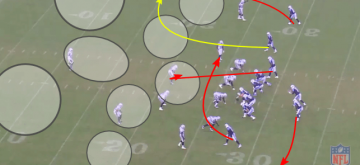
Situation: 2nd and 9 at NYG 18. Eagles and Giants are tied 7-7.
Description: (12:26 - 2nd) Nolan Carroll II 17 Yrd Touchdown Interception on Eli Manning. C.Sturgis extra point is GOOD, Center-J.Dorenbos, Holder-D.Jones.
Offensive Grouping: 11 (1 RB - 1 TE - 3 WR)
- The Giants are in shotgun slot left with Randle and Beckham as the outside wide receivers.
- Manning motions Odell Beckham closer to the formation.
- Cornerback #31 Byron Maxwell tightens his split to the middle of the field mirroring him.
- The Eagles have two deep safeties and are playing Cover 2.
- After the snap, #17 Dwayne Harris runs a quick-out route from slot, while Rueben Randle slips out of his break after #26 Nolan Carroll presses him.
- Manning immediately looks their direct after the snap, double-clutching it, before firing it towards Harris on the boundary.
- Carroll, still sitting at the line of scrimmage, has his eyes on Manning and intercepts the ball for an easy touchdown for the defense.
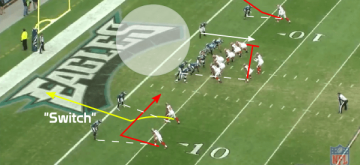
There are a few issues with this play. First, Randle slips before cutting inside. This keeps Carroll on the line of scrimmage in plain view of Manning. With the slot cornerback, Malcolm Jenkins on this play, he steps backwards expecting a slant-flat combination. This should immediately tell Manning to throw to Randle and not Harris. Third, Manning stares both receivers down, while his checkdown running back releases into the right flat completely open without any defenders within 10 yards of him.
Manning had plenty of time in the pocket and forced the football to Harris. Even though Randle slips and it throws the timing of this play off, Manning has to have better awareness to not throw this pass.
Looking at the play design, the left side is designed to beat man-to-man coverage with the rub-concept shallow crosses. The right side of the play is meant to overload the zones of a Cover 3 since the hitch by Beckham, and the spot route by the tight end would occupy the underneath linebackers.
Against a Cover 2 defense on 2nd and 9, there is no reason to throw this football. Checking down and gaining 3-5 yards through his running back is clearly the correct choice since he had plenty of time in the pocket.
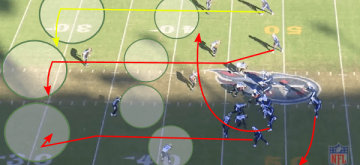
This issue accounted for eight of Eli Manning’s 14 interceptions in 2015. Here is another example versus the Minnesota Vikings.
Eli Manning attempts to force the football Hakeem Nicks, who was perfectly covered by Xavier Rhodes. Since both slant routes on the left side of the field were covered, Manning should have checked it down to his running back from the backfield.
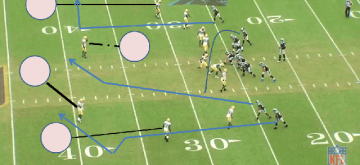
Here is one final example of this issue against the Washington Redskins.
Dwayne Harris runs a wheel route to the sideline versus the Redskins’ Cover 1 defense. The defensive line with Chris Baker and Ryan Kerrigan contain Eli Manning in the pocket not allowing him to escape or step into his throw.
This leads to one of the most ridiculous plays of the season as the ball bounces off the hands of Will Blackmon, Dwayne Harris, and then back into the hands of Will Blackmon since Kyshoen Jarrett levels Harris on the sideline.
Throwing Behind the Receiver
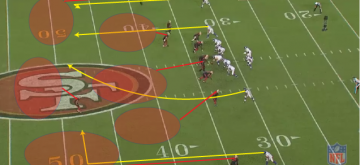
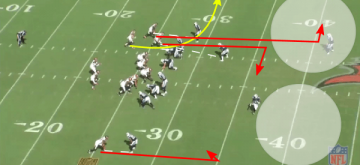
Three of Eli Manning’s interceptions were caused by innaccuracy. For example, against the Tampa Bay Buccaneers, Manning targets Odell Beckham on a slant route.
Manning reads this play correctly targeting Odell Beckham on the slant-flat combination against the Buc’s Cover 3 defense finding the zone, but he has to place this pass further ahead of the receiver allowing him to run after the catch. In this case, Beckham couldn’t get a clean grasp on the football, and it flew out of his hands right into the defenders’ hands.
Overall, eight interceptions were due to Manning forcing the football, three were caused by inaccuracy, and three weren’t the fault of him due to bad drops.
Last off-season I took a look at his 14 interceptions in 2014, and I noted that I didn’t see his touchdown to interception ratio improving significantly from last year. I would say that 31:14 and 35:14 (TD:INT) aren’t significantly different, and after reviewing his touchdowns and interceptions again this season, I am going to make that same prediction again.
Follow Samuel Gold on Twitter: @SamuelRGold.
If you liked our work, please do us a favor and Like us on Facebook and Follow us on Twitter.
Eli Manning, Film Breakdown, Football Breakdowns, Interceptions, INTs, New York Giants, QB, Quarterback

Similar Posts
About The Author
