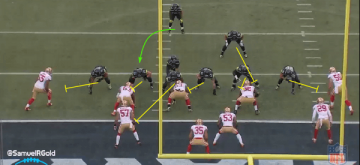
Scouting the San Francisco 49ers
49ers Offensive Overview
The 49ers offense in theory is based on the idea of wearing down the opponentwith a strong running game and then coming back with the play action pass to catch them off ground. This was the game plan against the Vikings and it worked very well as the 49ers had over 200 yards on the ground throughout the day and the play action was working effectively. In reality though, I’m honestly not sure what the identity of the offense is suppose to be at the moment. Against the Packers, the offense more looked like a spread option team that could not get anything going on the ground outside of Colin Kaepernick scrambling during passing plays. The passing game is influenced by the West Coast System as they make full use of the width of the field and they like to run a lot of crossing routes and curls. But they are not against taking shots downfield and using Kaepernick’s cannon for an arm as a weapon against the defense.
49ers Offensive Scheme
Stats
Note: The Giants have never faced offensive coordinator Geep Chryst so I don’t have film of him against the Giants
San Francisco 49ers vs. Green Bay Packers Week 4 2015
| 1st Down P/R % | 2nd Down and 6+ P/R % | 2nd Down and 1-5 P/R% | 3rd Down and 8+ P/R | 3rd Down and 4-7 P/R% | 3rd Down and 1-3 P/R% | 4th Down P/R% | Overall P/R% |
|---|---|---|---|---|---|---|---|
| 55% Pass | 71% Pass | 100% Pass (2 Plays) | 88% Pass | 100% Pass (4 Plays) | 100% Pass (1 Play) | 100% Pass (1 Play) | 72% Pass |
Overall Stats
| Rushing Yards Per Game | Passing Yards Per Game | Total Yards Per Game | Points Per Game | Turnovers |
|---|---|---|---|---|
| 130.3 (5th) | 158.8 (32nd) | 289.0 (31st) | 12.0 (32nd) | 7 (T-20th) |
Rushing Attack
Th 49ers only ran 14 running plays all game against the Packers so my knowledge of their running game is very limited. From what I saw against the Packers, the running game revolved around a zone blocking attack with a lot of read option mixed in.
Situation: 2nd and 10 at SF 32
Description: Q1-(8:25) C. Hyde Left Tackle to SF 39 for 7 Yard Gain
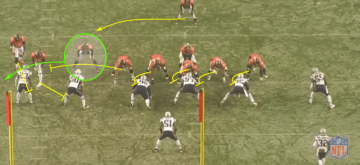
The zone blocking scheme doesn’t have assigned men to block when a run happens. Instead the offensive line creates a moving wall/wave that picks up defenders along the way by taking a 45 degree down step in unison and move the defense in the same direction as their down step. The RB is looking for a hole to open up in this wall and attack it with a quick cut. RBs in the zone running scheme therefore need to be patient runners or else they’ll just run into the back of linemen over and over again instead of hitting the hole that opens up. Defenses against the zone running scheme need to maintain gap discipline and clog up the running lanes. If the defender tries to freelance and jump out of their assigned gap to make a play, it will open up a hole for the RB to exploit. Gap penetration by the defensive line is also very effective against the zone run as the RB has to be patient in the system. Quick penetration has a very good chance of getting to the RB before the RB has made his cut up the hole and will likely lead to a tackle for a loss. RB Carlos Hyde on this play should of been stopped for a big loss as the DT gets great gap penetration past C Marcus Martin and is in Hyde’s face. Hyde shrugs him off though and finds the cutback lane as the OLB is washed down the LOS by TE Vance McDonald and doesn’t maintain gap discipline. It also helps that the CB gets blocked by both TE Garrett Celek and WR Anquan Boldin.
An extension of the zone blocking scheme is the zone read option:
Situation: 1st and 10 at SF 21
Description: Q1-(2:33) C. Kaepernick Right End to SF 30 for 9 Yards
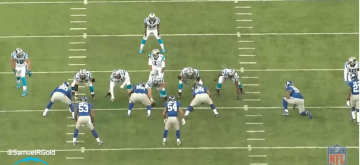
The zone read option looks almost identical to most zone plays on the offensive line and the goal of the offensive line is to create a moving wave like in a regular zone run play. The major difference though is that a defender on the edge of the offensive line is unblocked. Usually this is the DE but this can vary base on formation and defensive play call. The QB reads the DE and reacts to his movement. If the DE crashes down the line of scrimmage and makes a play on the RB, the QB pulls the ball out of the mesh point with the RB and runs to the outside. If the DE stays home, the QB presses the ball into the RB’s stomach to signal the RB should take the ball. The lead TE for the QB on this play is a more recent innovation and it is a reaction to how NFL defenses would loop a LB (usually the MLB) around the formation and use him as an edge defender. This would take away the QB run option of the play as it was very unlikely the offensive line was going to pick him up going against the grain of the play. The pulling TE is designed to pick him up and not force the QB to make the LB miss him on a tackle. On this play, the DE crashes down the line of scrimmage and Colin Kaepernick makes the right read to pull the ball. The lead TE Celek picks up the safety that came upfield at the snap of the ball, opening up a good running lane for Kaepernick to run through. I don’t think Kapernick made the right decision to go outside as Celek opened a huge running lane on the inside and McDonald had gotten up to the other safety effectively. The cutback by Kaepernick back to the inside gave the LB enough time to chase him down but it is still a very good gain.
The 49ers also run the veer read option (at least that is what I would call it) play as well and was there most common run play of the game:
Situation: 1st and 10 at GB 33
Description: Q2-(9:24) C. Kaepernick Left End to GB 16 for 17 Yards. Offensive Holding on V. McDonald Enforced at GB 23
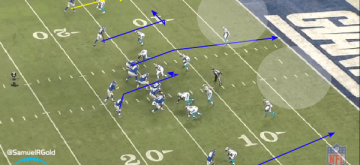
The difference with veer option versus the zone option the 49ers run is the blocking at the point of attack. The veer option has a combo block instead of the zone blocking to the side where the ball is being run. A combo block is as I mentioned last week is where two offensive linemen will initially double team a defensive linemen and then one of them will slip off the block to take on the LB. The best case scenario is the defensive linemen gets pushed back into the LB making the second stage of the block almost unnecessary. But the combo block can fail in multiple stages including the initial double team getting split, neither offensive linemen is able to get up to the LB, and the offensive linemen losing control of the defensive linemen when his partner in the block heads up to the LB. The way for the defense to beat the combo block is for either the defensive linemen to split or bog down the initial double team and/or the LB hit his run assignment faster then the offensive linemen can get off the double team to block him. The backside of the veer option are down blocking or cutting off pursuit from the backside. On this play the combo block goes poorly as LG Alex Boone falls over and the DT stonewalls the double team. Boone maybe should of been called for tripping on this play as he sticks his leg out trying to take out the LB coming through the hole. The OLB who is being red is in a very good position as he can take away the QB and RB potentially. This is a very hard read for the QB to make as neither decision is obviously right. Kaepernick decides to keep it and is able to beat the OLB to the edge for a big gain. Vance McDonald commits a hold on the safety though to get the play called back.
Passing Attack
The passing attack against the Packers resembled the west coast system with a lot of quick breaking and timing routes in the repertoire with a heavy dose of levels concept. The most common route combination was the double curl-cross combo:
Situation: 3rd and 8 at SF 11
Description: Q3-(14:19) C. Kaepernick Pass Short Right to Q. Patton to SF 35 for 13 Yards
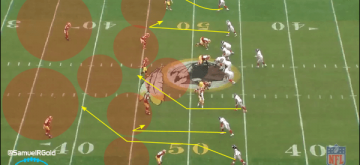
The goal of this play is to drag the zone coverage away from the direction of the cross with the curl routes. With the hook defenders occupied by the curls, the cross from the opposite direction of the curl routes will be uncovered leading to an easy reception with a lot of potential for yards after the catch. If the hook defenders following the crossing route, this opens up the curl route for an easy eight to ten yard gain and a likely first down. In zone coverage, the defenders need to recognize the multiple curl routes and seen the crossing route coming. The defenders then need to pass the crossing route across the zones and the defenders that pass the crossing route need to pick up the curl routes after the crosser moves through. This is a very hard route to cover in zone coverage and it takes a great deal of communication and play recognition to make this work. Man coverage is easier schematically to cover this route but the crossing route is one of the harder routes to cover in man coverage. On this play, the Packers play a man zone hybrid where the CBs are playing man and the LBs are playing zone. Both LBs are occupied by the curls and the CB in man coverage is beat pretty soundly by the crossing route. Kaepernick makes the easy throw and Quinton Patton has open field to pick up a first down.
The 49ers also ran multiple different levels like concepts against the Packers:
Situation: 3rd and 7 at SF 15
Description: Q3-(0:03) C. Kaepernick Pass Short Right to T. Smith to SF 22 for 7 Yards
As seen on the left hand side of the play, this version of levels concept involves two players crossing each other at different levels of the field. The goal of this route combo is drag the flat defender with the initial in route, opening up the deeper out route behind him. This is more effective when the defense is in Cover 2 because the safety sits in the seam area of the field and that opens up the deep outside of the field if the flat defender is dragged out of the flat. Against Cover 3, the deep third defender is going to sit on the deep out route, therefore the QBs best chance to compete a pass to the levels combination is for the in route to get in a hole in the zone coverage and the QB to hit the in route in one of these holes. On this play, the Packers are playing man coverage and Patton has gotten open on the in route. Since it is third and seven, this route wasn’t likely going to get a first down so Kaepernick goes to his right and the curl route by Torey Smith. Smith gets a yard a separation against the man coverage and Kaepernick uses his cannon of an arm to beat the CB with a low ball that only Smith can catch.
Situation: 3rd and 9 at SF 34
Description: Q1-(0:44) C. Kaepernick Incomplete Deep Right to T. Smith
This version of levels concept forces the hook defender in zone coverage into a bind. If the hook defender jumps the first in route, it opens up the deep in route behind him if the safety doesn’t jump the route. If he sits back under the deep in route, it opens the short route underneath unless a zone defender from the other side of the field picks up the in route. The deep in route also effective against Cover 3 because the deep in gets in the seam between the middle and deep third defender very easily and the window to throw it in if the hook defender jumps the short in route is very big. Cover 2 can do a better job at covering this route combo as the curl zone defender can jump the short in route, allowing the hook defender to sink on the deep in until the safety can pick up the route.
This play also contains the outside go with slot/inside quick out breaking route combo. This combination of routes is very common with the 49ers so it worth a look. This route is a tough combo to cover in a Cover 2 scheme. The CB in the flat will have to initially sink with the go route as the safety cannot get over to an intermediate sideline route in time to break up the play. This opens up the quick out breaking route underneath unless the hook defender follows the route and that is a lot to ask for a defense. If the CB doesn’t sink back and jump the out route the go route will be open 15 yards deep for an easy completion between the CB and safety. Against Cover 3, this is much easier to cover as the CB will just follow the deep route and the flat defender will follow the quick out. The best bet is to hit the quick out breaking route before the flat defender can get into the flat. On this play, the Packers run a Cover 1 with man coverage underneath. Every route is covered well by the man coverage, giving Kaepernick no where to throw unless he throws a perfect pass to Patton on the deep in route. Kaepernick tries to turn the go route into a back shoulder fade but throws it out of bounds and Smith is not close to catching the ball.
The 49ers have a big armed QB in Kaepernick and will call a few dedicated shot plays throughout the game.
Situation: 2nd and 9 at SF 34
Description: Q1-(0:52) C. Kaepernick Incomplete Short Right to V. McDonald
I’m going to be honest, I picked this example of a shot play because I grew up playing Madden and NCAA Football and this is mine (and many others) favorite play in the game. The goal of these shot plays is to try to overwhelm the deep coverage. If the defense only drops two or three back into deep coverage, this forces the deep zone defenders to sit between routes and have to try to take away multiple routes. This is very difficult to do and usually one of the deep routes will be given up. Its the QBs job to find this route and throw an accurate ball to beat the defense. The Packers on this play run there hybrid man/zone defense and they end up with man coverage on the outside deep routes. The safeties in the Cover 2 pick up the two deep routes effectively, neutralizing the play. There may of been a small window to hit Bolden between the safety and the nickeback but the pass rush gets on Kaepernick quickly from the blitzing LB and Kaepernick can’t get the ball off in time. Kapernick is forced to scramble for his life and McDonald does a good job working back to the QB to be available for a pass. Kaepernick throws a high but very catchable pass to McDonald who drops the ball.
Article continues on the next page.
Pages: 1 2 Single Page