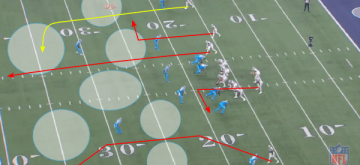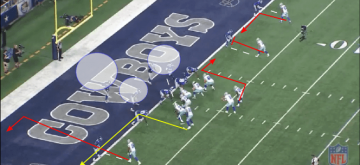
Teddy Bridgewater’s 9 Interceptions in 2015
Over my next few articles, I’m going to be covering the biggest positives (touchdowns) and negatives (turnovers) from some of the second-year QBs in 2015. This article will cover Teddy Bridgewater’s nine interceptions in 2015. First, I’m going to cover some charting data I came up with while watching his passing. Then, on page 2 and beyond, there are my thoughts on the individual plays themselves.
One of the first things I charted for each interception was blame. I assigned three categories, which should be self-explanatory:
Blame
| QB’s Fault | 8 |
| Partially QB’s fault | 1 |
| Not QB’s fault | 0 |
Teddy Bridgewater deserves blame for all of his 2015 interceptions. He did not throw any passes that were obviously the fault of his receivers, although there was one pass where the receiver deserved significant blame. The throw was a deep 50/50 ball, and while Teddy’s placement wasn’t perfect, his receiver (Stefon Diggs) could have done a better job to win possession of the football or at least force an incompletion. There were two other picks thrown in contested catch situations, but by my determination Bridgewater deserves full blame for those throws.
What caused the interceptions?
Cause
| Bad Decision | 5 |
| Bad Throw | 6 |
| Pressured | 4 |
| Great Defense | 5 |
| Dropped Pass | 0 |
| Tipped By Defense | 2 |
| Contested Catch Situation | 3 |
Since there’s overlap in these categories (you can make an ill-advised decision and still make a poor throw), these numbers do not add up to 9. On Bridgewater’s picks, defenders often made diving catches or won a battle with a receiver to get in position to make a catch, and those plays were marked as “great defense.” In another situation, Marcus Peters peeled off a vertical route to jump an underneath crossing route.
The contested catch situations are mentioned above, but deserve mention here as well. The Vikings’ receivers really struggled to win contested catch battles in the 2015 season, and it was often talked about in the process leading up to the draft. The ability of Laquon Treadwell and Josh Doctson to make these kinds of catches is a big part of the reason those two players were often mocked to the Vikings. Ultimately, the Vikings landed Treadwell, and the hope is that his physicality will help Teddy throw more successful 50/50 balls.
The root cause of Bridgewater’s interceptions was typically either a bad decision or a bad throw, although there were two plays where both the decision and the throw were issues. Typically, a bad decision by Teddy involved forcing a pass to a covered receiver, although he also misread the defense in a couple cases. The bad throws were typically ball placement issues, although he had one really boneheaded play and another throw that was wildly off target.
What about distance covered? Bridgewater’s average depth of target on these throws was 20.4 yards. Where on the field was he throwing the ball? Here’s a breakdown of each throw:
Distance Breakdown
| Fewer than 6 Yards | 1 |
| Between 6 and 15 yards | 0 |
| More than 15 yards | 8 |
Location Breakdown
| Deep Left | Deep Middle | Deep Right |
| 2 | 2 | 4 |
| Intermediate Left | Intermediate Middle | Intermediate Right |
| 0 | 0 | 0 |
| Short Left | Short Middle | Short Right |
| 0 | 1 | 0 |
When Bridgewater threw an interception in 2015, it was almost exclusively 15+ yards down the field. He did have a few throws clustered around that range, with 4 throws at depths of either 16 or 17 yards. He also struggled most throwing to the deep right area of the field, where 4 of his interceptions came from.
What about the time left on the clock? First, a breakdown of potential game situations, followed by a breakdown by quarter:
Situational Breakdown
| Crunch Time | 0 |
| Garbage Time | 0 |
| Desperation | 0 |
Quarter Breakdown
| 1st Quarter | 2 |
| 2nd Quarter | 3 |
| 3rd Quarter | 2 |
| 4th Quarter/Overtime | 2 |
The Vikings were pretty firmly in the game every time Bridgewater threw an interception.
The interception in week 1 against the 49ers did pretty much end any hopes of a comeback, because the Vikings were down by 14 in the 4th and were completely flat on offense all game, but most interceptions were in close games.
Two of his interceptions came after the 2-minute warning in the 2nd Quarter, where Bridgewater seemed to open up and take risks a bit more. Otherwise, there aren’t a whole lot of trends.
Now let’s take a look at the interceptions he threw by down:
Down Breakdown
| 1st Down | 3 |
| 2nd Down | 3 |
| 3rd Down | 3 |
| 4th Down | 0 |
Teddy appears to be equal opportunity as it pertains to which down he throws interceptions on.
What about the kinds of routes he was throwing to?
Route Breakdown
| Out | 3 |
| Vertical | 4 |
| Curl | 1 |
| Dig/strong> | 1 |
| Post | 1 |
| Crossing | 1 |
| Broken Play | 1 |
Bridgewater’s deep ball passing has been widely criticized and that shows up here. He really struggled with ball placement on vertical routes.
Finally, let’s take a look at who Bridgewater was targeting on his interceptions:
Receiver Breakdown
| Stefon Diggs | 3 |
| Mike Wallace | 3 |
| Kyle Rudolph | 2 |
| Charles Johnson | 1 |
Diggs, Rudolph, and Wallace were 1st, 2nd, and 3rd, respectively, in targets for the Vikings in 2015. Wallace and Rudolph were just one target apart. It makes sense that they were targeted on 8 of the 9 interceptions Bridgewater threw.
Johnson was nominally a starter until he was injured in the Chargers game, which is the game where he was targeted on an interception. There, he failed to win a contested catch situation, something he struggles with.
Since you’re probably tired of tables at this point, for the rest of the article I’m going to break down each TD pass from the film.
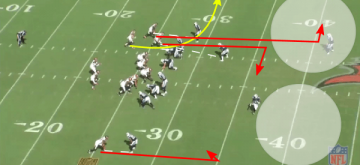
1-10-MIN 33 (Q4, 8:41) (Shotgun) 5-T.Bridgewater pass deep right intended for 82-K.Rudolph INTERCEPTED by 26-T.Brock [90-G.Dorsey] at SF 44. 26-T.Brock to MIN 30 for 26 yards (17-J.Wright).
On this play, the Vikings run a four verticals concept. All four receivers on the play run routes that break at least 10 yards downfield. From the top of the screen down, Mike Wallace runs a 15-yard curl, Kyle Rudolph runs a vertical route up the seam, Jarius Wright runs a “deep 6” or deep crossing route, and Charles Johnson runs a deep dig route.
Honestly, this is the most difficult to decipher interception Bridgewater threw in 2015. The throw is clearly way off target, but there are a couple of possible reasons why.
The first reason is pressure. The Vikings’ struggled to protect against the 49ers’ varied blitz packages in this game. On this play, Teddy gets hit right as he threw, which could have affected his follow-through and forced the ball high and wide of Rudolph, the apparent intended target (Rudolph was obviously quite open in the seam).
However, the Vikings also struggled to decipher the 49ers’ coverage throughout the course of the game. Most routes that receivers run have options built into them based on the coverage. If the QB and receiver aren’t on the same page, a pass could look wildly inaccurate, but the reason could be because the receiver and QB read the defense differently, meaning that the reason for the bad throw was due to a miscommunication.
On this play, the coverage appears to be a pretty straightforward Cover 3 shell with three zones underneath. It’s possible that there was a miscommunication in either the play call or in understanding the route options, and that Mike Wallace was supposed to run a post instead of a curl. Teddy throws the ball approximately where Wallace would end up on the post.
Ultimately, however, I chose to mark this as a bad throw by Bridgewater, feeling that he just missed on the throw to the wide open Rudolph. This turned a potential big gain on a drive the Vikings’ desperately needed to score on into a play that killed any hope the Vikings had left.
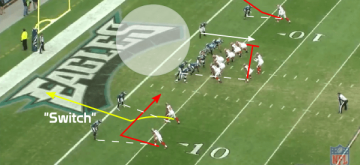
2-10-SD 24 (Q1, 9:02) (Shotgun) 5-T.Bridgewater pass deep left intended for 12-C.Johnson INTERCEPTED by 23-S.Williams at SD -3. Touchback (12-C.Johnson).
For some added context to this play, on the previous down Teddy threw a pass to Kyle Rudolph should have been an easy TD, but Rudolph dropped it. On 2nd Down, the Vikings chose to take another shot at the end zone.
The design of this play is clearly intended to give Charles Johnson an opportunity to catch a 50/50 ball. The Vikings line up with trips left, and both Mike Wallace and Jarius Wright run in-breaking routes while Johnson runs a wheel route. At the top of the screen, Rudolph runs a vertical route as well.
The Vikings make an interesting protection call on this play, going full slide to the left and leaving Melvin Ingram unblocked. It’s possible that Adrian Peterson was tasked with picking up Ingram, but that he chose to continue the play action fake instead, or that Matt Kalil made a mistake. Either way, the unblocked defender in his face led to an increased level of difficulty for Bridgewater’s throw.
Teddy’s throw is bad. Johnson is outside the CB the whole time, but the throw, rather than leading Johnson closer to the sideline, forces him to work back inside. Had Teddy placed the ball on the sideline, it would have made the interception significantly more difficult. Therefore, I place the blame clearly on Bridgewater. There are some receivers in the league who might be able to force their way into a catch on this play, but Charles Johnson is not one of them, and that would be incredibly difficult to do without committing OPI.
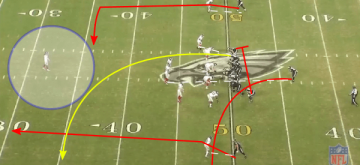
3-15-KC 15 (Q1, 10:54) (Shotgun) 5-T.Bridgewater pass deep right intended for 82-K.Rudolph INTERCEPTED by 38-R.Parker [97-A.Bailey] at KC -1. 38-R.Parker pushed ob at KC 4 for 5 yards (82-K.Rudolph).
Here, Teddy had just been sacked the previous play, and it’s 3rd and goal. The Vikings are looking to score to take an early lead on their first drive of the game.
At the bottom of the screen, Kyle Rudolph chips before releasing on a curl short of the end zone. Mike Wallace runs a crossing route over the middle, while Stefon Diggs and Jarius Wright both run vertical routes to nearly the same place, with Wright trailing Diggs. This doesn’t make sense, and it’s likely one of the two mixed up his assignment.
However, the mistake by Diggs or Wright doesn’t matter, because Brandon Fusco fails on his block and Teddy is forced to his right. Hurried and trying to make something happen, Teddy tries to force a throw to Rudolph. This is a really bad decision, as Rudolph is well covered and short of the end zone anyway.
This is a contested catch situation, so Rudolph could do a better job of shielding and fighting for the ball, but it’s also not perfect placement. The pass gets tipped, and Ron Parker makes a diving catch to rob the Vikings of a scoring opportunity.
Bridgewater should have just thrown the ball away here.
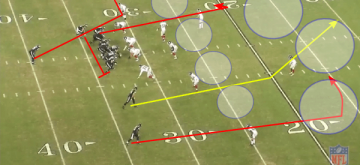
1-10-KC 40 (Q4, 11:18) (No Huddle, Shotgun) 5-T.Bridgewater pass deep right intended for 11-M.Wallace INTERCEPTED by 22-M.Peters at KC 23. 22-M.Peters to KC 23 for no gain (11-M.Wallace). Penalty on MIN-75-M.Kalil, Offensive Holding, declined.
In this situation, the Vikings are looking to move into scoring position to extend their lead in a tight game early in the 4th Quarter.
From right to left, the Vikings have Rhett Ellison run a vertical route, Kyle Rudolph run what’s known as a “pivot” route in the Turner offense, Adrian Peterson run a swing route into the flat from the backfield, Mike Wallace run a deep cross, and Diggs run a deep dig.
On this play, Bridgewater makes bad assumption. He clearly thinks that CB Marcus Peters will follow Ellison on his vertical route, but Peters has his eyes in the backfield and peels off that route, instead jumping the throw to Wallace. Bridgewater’s throw led Wallace too far, and Peters was able to make the catch uncontested. It doesn’t even seem that Wallace sees Peters, as he slams into him immediately after Peters makes the catch.
3-10-MIN 32 (Q2, 1:13) (Shotgun) 5-T.Bridgewater pass deep left intended for 14-S.Diggs INTERCEPTED by 23-K.Fuller at MIN 49. 23-K.Fuller to MIN 34 for 15 yards (11-M.Wallace).
On this play, the Vikings are looking to hurry up and move down the field little with a chance to score before the half.
From the top of the screen down, they start off with Wallace running a drag route, Rudolph running a deep out, Wright running a post, and Diggs running a deep dig. Jerick McKinnon pops out of the backfield as a checkdown option on a swing pass.
On this play, Bridgewater has good protection and a lot of time to make a decision. One of the Bears’ two safeties screws up, and fails to bail deep. Wright wins a step on the CB on the post, and is steaking down the field open. Bridgewater should target him. Instead, he chooses to target Diggs.
Kyle Fuller initially lost to Diggs on the vertical part of his stem. Diggs got good initial separation, but the deep safety meant that a vertical route was not really a thread. Instead, Fuller did a good job of recovering and getting in really good position to defender the dig route.
Teddy held onto the ball for quite a while here, and eventually pressure broke through. However, he still had plenty of time to make this decision and throw, and he chose poorly, targeting Diggs while Fuller was in great position. The deep shot to Wright would make much more sense.
1-10-STL 38 (Q3, 14:20) 5-T.Bridgewater pass deep right intended for 14-S.Diggs INTERCEPTED by 22-T.Johnson at STL -3. Touchback (14-S.Diggs). Penalty on MIN-14-S.Diggs, Offensive Pass Interference, declined.
On this play, the Vikings are looking to strike quickly and take the lead after the half. They are on the verge of scoring position. Here, they keep 7 players in to protect, and the Rams run a zero blitz, leaving only three players running routes and three in man coverage.
Stefon Diggs, at the bottom of the screen, runs a vertical route. Mike Wallace runs a post. Rudolph runs an out at the sticks.
Pressure breaks through quickly, and Bridgewater decides to take a shot and throw deep to Diggs. Diggs fails to earn separation from Trumaine Johnson, but Bridgewater’s ball placement does him no favors. To catch this pass, Diggs would have needed to work through Johnson’s body. Instead, he ends up committing pass interference.
Despite the subpar placement, this is the only interception where I didn’t fully fault Bridgewater. I gave him partial fault because of the pressure he was facing, as well as the fact that a more physical receiver actually had a really good chance to catch this pass. The Vikings did not have that kind of player on their roster in 2015, but this is a pass that a number of the #1 WRs around the league could have come down with.
2-8-ATL 22 (Q2, 14:23) 5-T.Bridgewater pass deep right intended for 82-K.Rudolph INTERCEPTED by 37-R.Allen at ATL 0. Touchback.
The Vikings are in scoring position again, and they go with 22 personnel. Here, Rhett Ellison runs a wheel route, Rudolph runs a seam route, FB Zach Line stays into block, Peterson runs a checkdown route, and Charles Johnson runs a vertical route at the top of the screen.
On this play, Teddy makes a mistake by failing to move the safety, Ricardo Allen, out of the play. He certainly attempts to, looking in Johnson’s direction and executing a pump fake, but he fails to move Allen enough.
This means that when Bridgewater comes back to throw the seam to Rudolph, Allen is there to jump the route and make a very nice diving catch for the interception.
2-4-MIN 33 (Q2, 1:21) 5-T.Bridgewater pass deep left intended for 14-S.Diggs INTERCEPTED by 29-E.Thomas at SEA 40. 29-E.Thomas to MIN 35 for 25 yards (14-S.Diggs). PENALTY on MIN-14-S.Diggs, Face Mask (15 Yards), 15 yards, enforced at MIN 35.
The Vikings struggled mightily and got blown out against the Seahawks, but in this situation they are down 14-0 and trying to gain some momentum with a score going into halftime.
From top to bottom, the Vikings have Jarius Wright run a snag route, Adam Thielen run a post from the slot, and Stefon Diggs run either a dig or a post from the slot. Adrian Peterson is the checkdown option out of the backfield.
Diggs gains separation from Shead on his route and Bridgewater has a clean pocket, so this play should work. However, Bridgewater and Diggs do not appear to be on the same page. Diggs initially starts his in-breaking route as though it were a dig route, but when Bridgewater releases the ball he has to bend the route up field to try and catch it. He does tip the pass, but it falls into the arms of Earl Thomas, who made a nice adjustment for the catch.
Without being in the Vikings meeting room, it’s not really possible to know who is at fault. If Diggs was supposed to run a post, he is at fault. However, Teddy simply could have missed the throw or it’s also possible that Teddy should have thrown a dig instead. I faulted Teddy with a bad throw on this play.
3-5-MIN 39 (Q3, 6:35) (Shotgun) 5-T.Bridgewater pass short middle intended for 11-M.Wallace INTERCEPTED by 33-M.Hyde [96-M.Neal] at MIN 43. 33-M.Hyde to MIN 43 for no gain (17-J.Wright).
This interception is unquestionably the worst interception Bridgewater threw in 2015. The play design doesn’t really matter, because Teddy feels pressure and rolls to his left with Mike Neal hanging on him. He switches the ball to his left hand and tries to lob a pass to Mike Wallace.
Micah Hyde made a fantastic catch, but the play is just boneheaded by Teddy. There’s simply no excuse for trying to force a pass with your non-throwing hand to a receiver who is well-covered. Bridgewater lost his cool under pressure and made a costly mistake.
In Teddy Bridgewater’s sophomore season, he did not put up volume stats that met preseason expectations, and has met significant criticism for that. Despite lackluster yardage and TD numbers, Bridgewater generally did a solid job of taking care of the ball, with few turnovers. That does not mean, however, that he was completely mistake free. As a passer, he was occasionally prone to bad decisions and poor ball placement that led to interceptions.
As Teddy advances in his NFL career, he will need to correct these mistakes. Some of it may come from personnel concerns, which the Vikings hope they have shored up by drafting Laquon Treadwell #23 overall. However, Bridgewater showed some decision-making and ball placement flaws that will need to be corrected on the plays where he threw interceptions.
If you liked our work, please do us a favor and Like us on Facebook and Follow us on Twitter.
Film Breakdowns, Football Breakdowns, INT, INTs, Minnesota Vikings, QB, Quarterback, Teddy Bridgewater